A Mistake of taking Walpole at his word
For more than 270 years we have taken Horace Walpole‘s word about a sixteenth-century Italian tale drawing on Persian and other narrative traditions he likely never finished.
Almost every book, keynote and innovation report that mentions serendipity tells the same origin story about Peregrinaggio. In 1754 Horace Walpole coined the word after a “silly fairy tale” about three princes who were “always making discoveries, by accidents and sagacity, of things which they were not in quest of.” Then comes the lesson: be open, stay curious, and luck will find you.
Careful scholars have noticed pieces of a different story. Theodore G. Remer, Robert K. Merton and Elinor Barber, and Pek van Andel have each questioned parts of it. But when you put the pieces together and go back to the letter and to the tale itself, serendipity starts to mean something quite different.
During my rigorous research for the book I found something sensational. Here are my five findings, which will question Walpole’s interpretations – and hence the entire definition of serendipity.
1. The forgotten first half of the letter
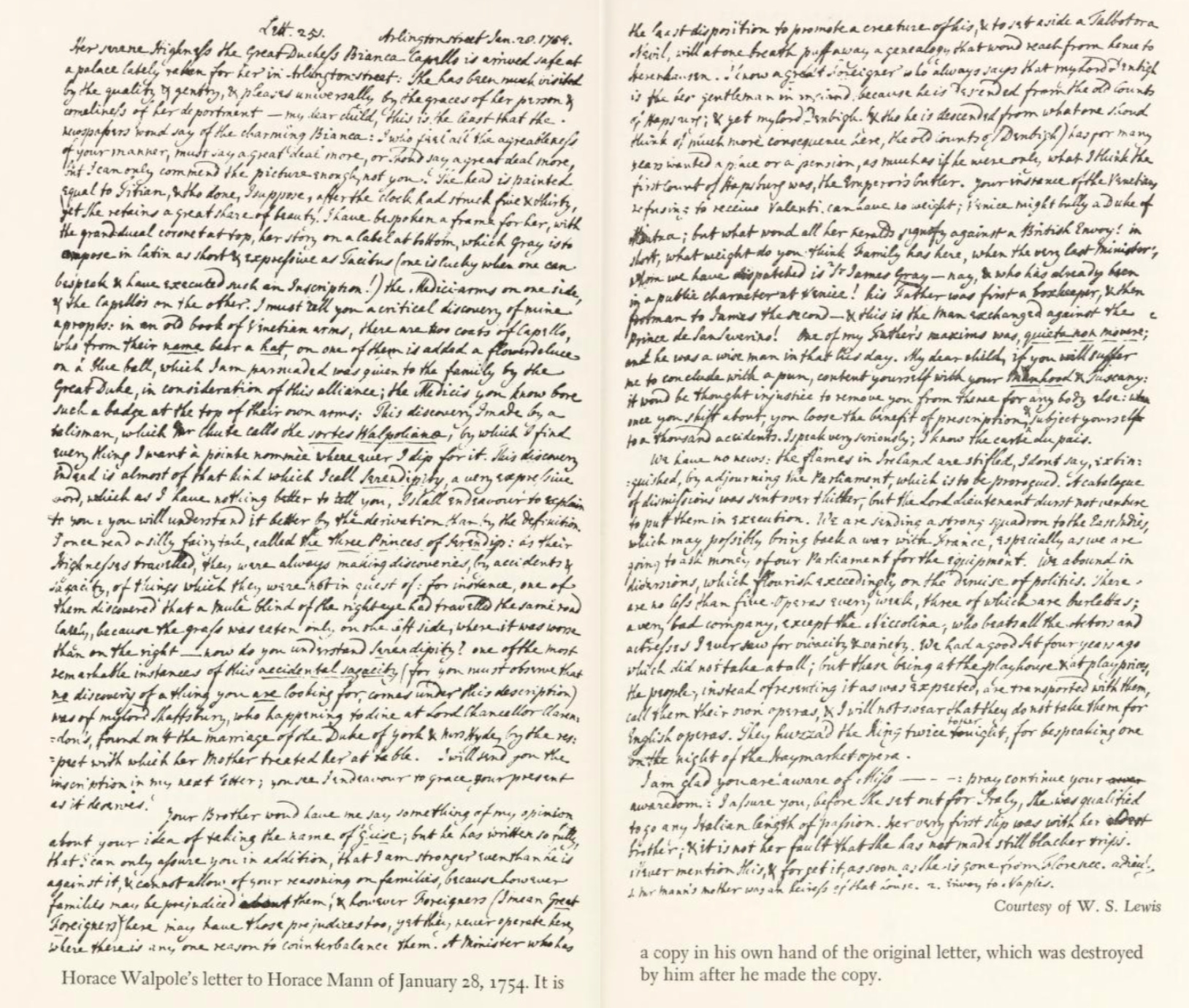
The word was born in a letter from Walpole to his friend Horace Mann, dated 28 January 1754. Most writers quote it from the sentence “This discovery indeed is almost of that kind which I call serendipity…” But “this discovery” points back to something. What?
The letter begins with a portrait of Bianca Capello that Mann had sent him, and a frame Walpole was having made for it, with the ducal coronet and the arms of the Medici and the Capello. Then he writes:
“I must tell you a critical discovery of mine a propos: in an old book of Venetian arms, there are two coats of Capello…”
On one of them he found a fleur-de-lis on a blue ball, which he took to be a grant from the Grand Duke in honour of the marriage. He made this discovery, he says, “by a talisman, which Mr Chute calls the sortes Walpolianae”. Only after that does the famous passage arrive:
“I once read a silly fairy tale called The Three Princes of Serendip: as their highnesses travelled, they were always making discoveries, by accidents and sagacity, of things which they were not in quest of…”
So the coinage was occasioned by Walpole’s own heraldic find, not from a silly fairytale he once read (maybe years ago). The tale supplied only the name. Walpole says so himself: “you will understand it better by the derivation than by the definition.” Cut the first half away and serendipity becomes a story about princes. Keep it and it becomes a story about a collector who was very pleased with his own knack.
2. An example with sagacity but no accident
Now read the tale itself. The best source in English is Remer’s Serendipity and the Three Princes (University of Oklahoma Press, 1965), the first direct translation from the Italian original.
The princes don’t stumble on anything. They meet a camel driver who has lost his camel, and they describe the animal they never saw: blind in one eye, because the grass was eaten on only one side of the road; carrying butter on one side and honey on the other; with a pregnant woman riding it. Every detail is inferred from traces. That is observation, anomaly detection and abductive reasoning, the leap from a surprising clue to the best explanation. The result is a better story than anyone else in the room could tell.
Walpole’s summary even gets the animal wrong. He turns the camel into a mule.
A fair critic will say that in 1754 “discovery” could also mean “finding out”, so the princes’ inferences do count as discoveries in that older sense. Agreed. But that does not save the other half of the formula. Nothing in the episode happens by accident. It is sagacity all the way down. Walpole’s own example contains sagacity but no accident. It is clever abductive reasoning, not luck.
3. The tale he probably never finished
Walpole picked the first clue of the first episode. Even Merton and Barber, in The Travels and Adventures of Serendipity (Princeton University Press, 2004, p. 3), wonder whether Walpole “never got any further in this ‘silly fairy tale'”.
It would explain a lot, because the richer material comes later. The princes practise observation and inference for the sheer pleasure of it. Later still, they save Emperor Beramo from a treacherous counsellor, through careful observation and a sharp understanding of human psychology. That is sagacity in the service of someone else: noticing what others miss, interpreting it, and letting the ruler act on it. In the language of my book, it is jesterish.
The best illustration of the insights was in the book all along. Finding Diliramma after a careful strategic framing and suggesting the construction of seven palaces in every corner of the empire is the jewel in crown in this masterpiece. Walpole most likely never read that far.
4. A word he never used after this letter
If Walpole was so proud of his “very expressive word”, you would expect to find it all over his correspondence. He wrote more than 4000 letters. Yet Merton and Barber state plainly (p. 9):
“Serendipity occurs only once in all of Walpole’s writings.” As far as the surviving record shows, the letter to Mann is the only place.
The very next opportunity proves the point. On 2 March 1754, barely five weeks later, Walpole wrote to Richard Bentley about “a new instance of the Sortes Walpolianae” that had helped him identify a portrait. A perfect occasion for his new word, and he didn’t use it. For his own lucky finds, Walpole preferred his friend’s Latin joke. The word that now fills management books was, for its inventor, a one-off.
5. A pilgrimage translated as an adventure
The original tale was printed in Venice in 1557 by Michele Tramezzino as Peregrinaggio di tre giovani figliuoli del re di Serendippo, attributed to one Cristoforo Armeno. Peregrinaggio means pilgrimage, or peregrination: a formative journey of becoming, not an expedition.
Walpole did not encounter the Peregrinaggio in its original Italian form. The version available to him had already passed through de Mailly’s French adaptation, titled Le Voyage et les aventures des trois princes de Sarendip (1719). An English translation followed in 1722 as The Travels and Adventures of Three Princes of Serendip. The shift from pilgrimage to travels and adventures had therefore happened before the story entered English. De Mailly also expanded and reshaped the Italian narrative. What might serendipity research have noticed if it had returned more often to the Peregrinaggio—and asked what the princes’ journey was for?
The difference matters. In the tale, King Jaffer (Giaffer) has his sons educated with great care and then sends them out into the world to gain the wisdom and virtue they will need becoming wise rulers. And that is exactly what they find.
Their main and only discovery is something they were in quest of. Walpole’s argued in his letter the princes finding always things “not in quest of”.
On the tale’s own terms, his entire interpretation of lessons learned doesn’t hold. Peregrinaggio is not an expedition.
Walpolean serendipity and Authentic Serendipity
Put the five findings side by side and two very different ideas appear.
Walpolean serendipity is the sortes Walpolianae: lucky finds by a well-read collector, wrapped in a story he half remembered. It is the version that won. It reduces serendipity to “finding something unexpected”, and it quietly invites us to treat it as luck.
Authentic Serendipity is what the princes actually show: a faculty of sagacity. It is observant, abductive, playful and collective, and it is put to work for ruling, managing and making strategic decisions. The three brothers reason together, test each other’s readings, and turn anomalies into insight that serves the emperor. They were court jesters on a pilgrimage.
None of this makes the careful scholars wrong. Remer gave us the tale, Merton and Barber gave us the history of the word, and van Andel catalogued its patterns. What changes when you combine their pieces is the meaning: the word’s definition comes from Walpole, not from the tale, and the tale itself describes sagacity on a quest, not accidental discovery.
This is the fact we have been missing for a very long time. And my book reveals it in more detail and rigorous argumentation.
The two are not rivals. Walpolean serendipity – the art of benefitting from unexpected – is a well-established research field, and it deserves to stay one. Authentic Serendipity is a new coinage that needs research on its own terms.
One is about finding, the other about becoming.
In my book Authentic Serendipity – and Why We Need 21st-Century Jesters you’ll find a full comparison of the two across eleven dimensions, from origin and orientation to their potential for being cultivated in organizations (Table 1, p. 96).
What this means for organizations today
Much of today’s serendipity talk rests on the Walpolean version. Open offices, random coffee pairings, innovation districts built for “collisions”. All of it assumes that more chance encounters will produce more insight. But coincidensity is not serendipity. Density raises the number of encounters, not the quality of connections .
The princes had no luck to rely on. They had a purpose, trained attention, each other, and a ruler willing to listen. That is a very different starting point from hoping to bump into something.
The Walpolean language of accidental discovery has always been difficult to bring into a boardroom: what, exactly, is a leadership team supposed to decide or invest in? Authentic serendipity makes the process discussable: notice a meaningful anomaly, ask “What if…?”, develop a better story together, and put it to work. Leaders can then build the conditions for that process and judge whether it creates value.
What if serendipity was never about what we stumble upon, but about what we are on a pilgrimage to become?