Six boxes of business cards, thousands of encounters, and the uncomfortable truth about modern networking culture.
We were moving house some time ago – and living in same house almost 20 years gathers all kind of stuff to corners and archives. I found six (!) boxes full of business cards, but instead of just putting them,in dust bin – I spent some time going throug those visiting cards. Out of maybe 2000- 2500 I could recognize people I still remember, which I have had some correspondence straight after the event and a few who could enter to my Dunbar’s number archive. So the shocking result 1:70 some action but no connection 1:250 turned out to fit my Dunbar number! (In cover pic one of the six boxes)
So, that sparked me to think about “networking” from a new perspective => I have met thousands of people during my professional life. Some wanted to get to know me. Others wanted to know what they could get from me.
Over time, I learned to recognise the difference. I have a name for the latter: Coincidensity Hunters.
In today’s hyper-connected world this archetype has become increasingly common and they have even changed the ambience of these events in just ten years time.
You recognise them immediately. They treat every networking event, conference, virtual meet-up – or even outdoor activities – as a numbers game.
They proudly declare they are “increasing their luck surface area,” by their elevator pitches and artificial curiosity. Their strategy is simple and relentless: maximise volume.
What “Coincidensity” Really Means
The term coincidensity was originally introduced by Matt Biddulph (formerly of Dopplr) and later further highlighted by Stowe Boyd. It describes the powerful combination of coincidence and density that naturally generates unexpected encounters. These are the defining characteristics of dynamic metropolitan areas — and often also of well-functioning virtual communities.
Coincidensity is real and often valuable. It increases the raw probability of chance meetings, ideas, and weak ties. But here is the crucial distinction:
Coincidensity is not serendipity.
When people become excited about “engineering serendipity” through more events, more connections, and more random encounters, they are in fact only engineering coincidensity. The desire for unexpectedness is a fairly recent phenomenon, introduced by those who want to turn serendipity into a manageable process. The Coincidensity Hunters are not necessarily interested in meeting you, they are interested in discovering what use you might be to them.
The Fundamental Misconception
Coincidensity Hunters confuse social density with insight generation.
They prioritise quantity over relevance, activity over timing, and motion over meaning. They rarely respect other people’s time and often lack the emotional intelligence to read whether the other person is genuinely open to engagement or simply wishes the conversation would end.
This constant drive also pushes against a fundamental human limit: Dunbar’s number — the cognitive capacity to maintain only about 150 stable social relationships. Beyond that, connections become superficial and lack the depth needed for real insight or collaboration.The result is a modern paradox: the harder they hunt for coincidences, the less likely they are to succeed in their current endeavours and implement something of lasting value.
The Forgotten Person in the Encounter
There is something fundamentally missing from almost all the advice we receive about networking: the perspective of the person being approached.
The networking gurus enthusiastically encourage us to approach strangers, start conversations, perfect our elevator pitches, expand our networks and increase our so-called luck surface area. Everything revolves around the person taking the initiative.
But what about the person on the receiving end?
That person has a life of their own. Their own interests, commitments, priorities and reasons for attending the event. Perhaps they are looking forward to meeting someone specific. Perhaps they are enjoying a quiet moment between presentations. Or perhaps they simply have no interest whatsoever in listening to another rehearsed elevator pitch. Yet the Coincidensity Hunter arrives, convinced that every new encounter represents another potential opportunity.
An opportunity for whom? This is the asymmetry that networking culture so often overlooks. The initiator controls the approach. The recipient controls their response. Neither can create a meaningful relationship alone.
And there is an even more uncomfortable question beneath all this.
Are You Interested in Me — or in What You Can Get from Me?
During my professional life, I have met thousands of people. Some were genuinely curious about who I was, how I thought and what I had experienced. Others seemed primarily interested in discovering what I might be able to offer them.
Over time, I learned to recognise the difference.
There is nothing wrong with approaching someone because their expertise interests you, or because you see possibilities for professional collaboration. Business relationships naturally involve mutual interests and complementary capabilities.
But there is an elementary difference between being genuinely interested in another human being and treating that person primarily as a resource for achieving your own objectives.
We have become remarkably comfortable with expressions such as human resources, human capital, talent acquisition, leveraging relationships and exploiting networks. I have never particularly liked this vocabulary. It can reduce human beings to assets, instruments and opportunities to be utilised.
Of course, many people working in Human Resources genuinely care about people. My objection is not to the profession, but to the instrumental mindset that such language can sometimes reinforce. And Coincidensity Hunters seem to have adopted precisely that mindset.
They may appear curious, friendly and enthusiastic. They may even have mastered the art of asking thoughtful questions. But genuine curiosity and strategically manufactured curiosity are not the same thing.
The difference often becomes apparent when they discover that you have nothing immediately useful to offer. Suddenly, their curiosity evaporates.
When did getting to know another human being become a strategy for extracting value from them? Perhaps this is the most troubling aspect of modern networking culture. We have become so accustomed to treating relationships as potential assets that we sometimes forget a simple truth: the other person is not there to serve our ambitions. And no amount of networking activity can manufacture genuine mutual interest.
An introduction can be initiated by one person. A relationship requires two.
That is something worth remembering before approaching the next stranger with yet another carefully rehearsed elevator pitch.
Now They Found a New Scene: LinkedIn
The perfect habitat for Coincidensity Hunters is no longer just the conference hall or the metropolitan lobby. They have discovered a far more efficient (they believe!!) hunting ground: LinkedIn.
Just few weeks ago, a post titled “How to become luckier in 2026” collected more than 700 likes within days. The content was the usual checklist: talk to strangers, embrace rejection, always have a project on the go.
What makes this revealing is not the post itself, but who is engaging with it.
Many of the likes and comments come from the very same Coincidensity Hunters who proudly declare they are “increasing their luck surface area.” They are not engaging because the advice is profound. They are engaging because the algorithm rewards visible activity — and because publicly liking and commenting on popular (yet shallow) content is now seen as a low-effort way to stay visible, stay relevant, and perhaps catch someone else’s attention. In other words: they are hunting coincidences on the platform that was literally built to maximise coincidensity.
Coincidencity Hunters believe that LinkedIn has become the ultimate coincidensity machine. They falsely perceive that LinkedIn optimises for volume, visibility, and weak ties; that it rewards the hunter who posts, likes, comments, and reposts the most — often without any real depth or follow-through. For them the platform itself turns the very act of “networking” into a performance sport.This is why the 700+ likes tell us less about the quality of the advice and more about the audience: a large portion of them are looking for the algorithm to reward them.
Seven hundred likes tell us that the message resonates. They tell us remarkably little about whether the advice produces meaningful encounters, lasting relationships or genuine value.
The irony is hard to miss: the same people who claim to be mastering serendipity are, in reality, optimising for the very thing that most often prevents it — endless low-value noise.
Authentic Serendipity: A Different Game
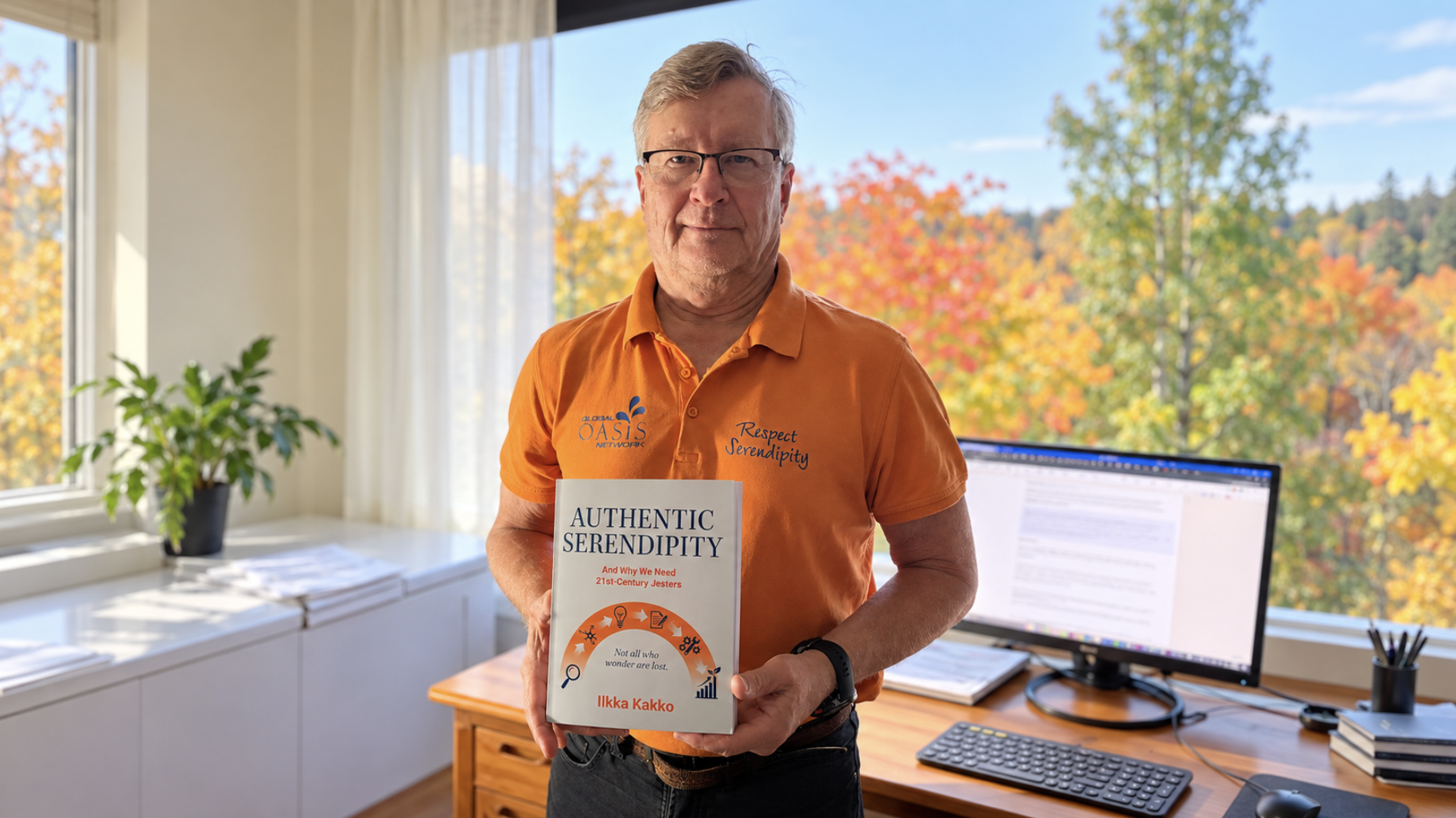
Authentic Serendipity is my coinage — a deliberate attempt to reclaim the true lessons of the original Peregrinaggio di tre giovani figliuoli del re di Serendippo (1557).
Unlike Walpolean serendipity, which reduces the story to a lucky accident or “finding something you were not in quest of,” Authentic Serendipity restores what Walpole obscured: the princes’ purposeful journey (peregrinaggio) for wisdom to rule. The three princes were not randomly hunting for treasures. They were on a carefully prepared quest for sagacity — the quality that turns anomalies into actionable insight.
At its core, Authentic Serendipity is a structured, forward-looking process.
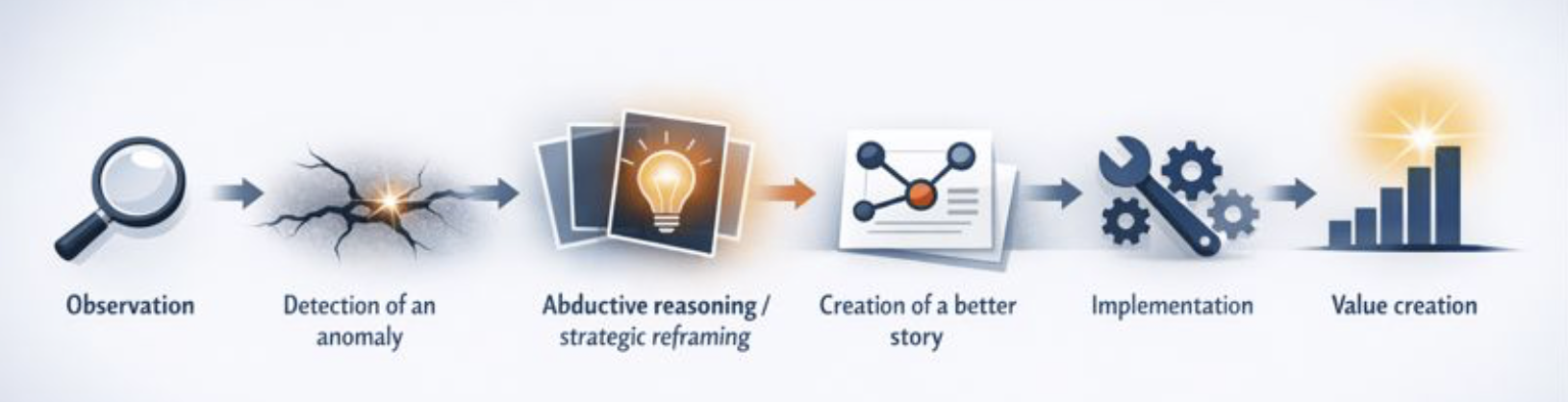
It begins with sharp observation and the detection of an anomaly, moves through abductive reasoning and strategic reframing to create a better story, and culminates in implementation and real value creation.
This process is illustrated in the framework I developed:
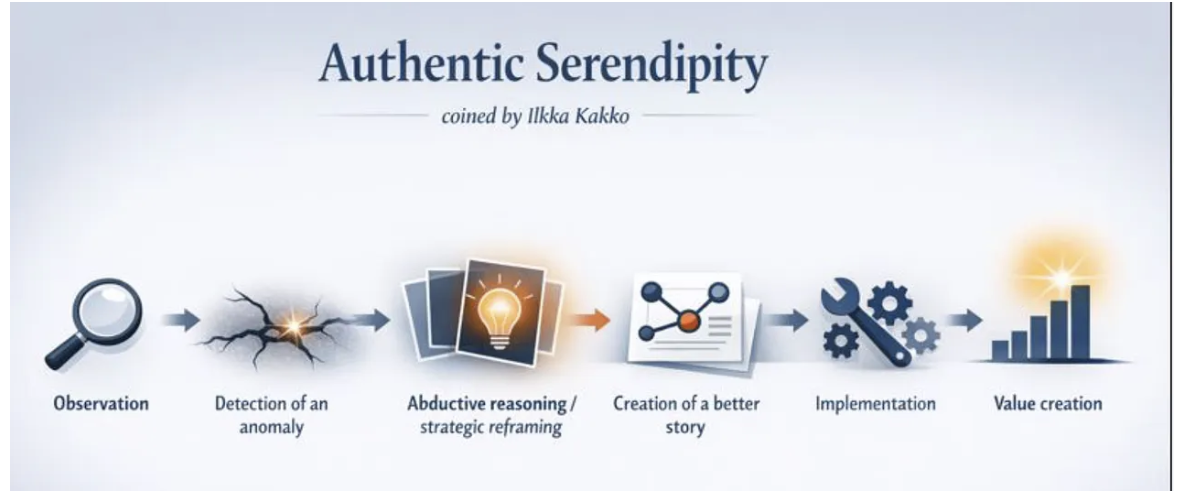
The princes demonstrated this throughout their Peregrinaggio: whether reconstructing the story of a missing camel from subtle clues, exposing a counsellor’s hidden intentions, or uncovering Diliramma’s mysterious past, they combined careful observation, abductive reasoning and collective sagacity to reveal what others had overlooked.
In each case, the decisive factor was not the number of encounters or fortunate coincidences, but the ability to recognise meaningful anomalies, question prevailing assumptions and deliberately construct a better explanation.
This is precisely what distinguishes Authentic Serendipity from Walpolean serendipity. The former is purposeful, forward-looking and grounded in collective sensemaking and value creation; the latter remains largely subjective, retrospective and vulnerable to the seductive narratives of unexpected discoveries and happy accidents.
Final Reflection
The next time you encounter a Coincidensity Hunter enthusiastically chasing the next random connection, remember this distinction:
They are not hunting for serendipity.
They are hunting for coincidences — and hoping that quantity will somehow substitute for quality, timing, and depth. This is happening in conferences, cocktail parties, social gatherings and even outdoor activities.
What could be worse than getting a Coincidensity Hunter in your tee-off group during a game of golf!
Timing is more important than action. A prepared mind noticing the right moment will always outperform someone who simply talks to more people.
May Kairos be with you in the jungle full of Coincidensity Hunters.