My exploration of what I now call the Jester’s Inner Circle began with a re-reading of Arthur Koestler’s masterpiece The Act of Creation. Koestler was the spark that started everything. I had already known Gary Klein’s work on insight and Alex Pentland’s research on social dynamics and idea flows through my professional contexts. But it was a remarkable weekend in 2015 spent at the home of Pek van Andel — my serendipity mentor — that truly changed the direction of my thinking.
We talked for hours about the origins, mechanisms, and real-world impact of serendipity. By the end of that weekend I had become, quite consciously, a “pekvanandelist.” Kahneman arrived later as the newcomer to the picture. It was only when I began actively connecting these five voices — Koestler on bisociation and the creative leap, Kahneman on the architecture of judgment and noise, Klein on insight under pressure, Pentland on the social physics of idea flow, and van Andel on the rigorous science of serendipity — that something new and coherent emerged.
I realized these thinkers could be brought together to form a fresh theoretical foundation for understanding the modern jester archetype: figures who cut through illusion, reduce harmful noise in judgment, create conditions for genuine insight, and cultivate fertile ground for serendipity.
When Robert Merton’s foundational work on serendipity is added to the mix, the framework also opens powerful new avenues for serendipity research itself.
As far as I know, this particular synthesis — this way of putting these five thinkers (plus Merton) into productive conversation — has not been made before. It is one of the central messages of my forthcoming book Serendipity Unleashed: Hidden Wisdom of the Jesters.
Two members of this circle — Koestler and Kahneman — ultimately made the most personal judgment of all. Both chose to end their lives on their own terms when facing decline. Koestler in 1983, together with his wife Cynthia, as he battled Parkinson’s and leukemia. Kahneman in 2024, through assisted dying in Switzerland, while still active and content but determined to avoid what he called the “miseries and indignities of the last years of life.” Whether coincidence or something deeper, their choices echo the very work they devoted their lives to: exercising radical clarity and autonomy in the face of uncertainty and human limitation.
This post explores that tradition through their key ideas and recommends the books that best capture their contributions — with a special focus on Daniel Kahneman, whose two major works have transformed how millions understand (and improve) their own thinking. And maybe Koestler’s and Kahneman’s final choices might reveal something about the jester archetype itself.
Five Complementary Voices in the Art of Clear Seeing: 21st-Century Jester’s Inner Circle
Putting these five masterminds together was not at all obvious. It required genuine insight and considerable time for the imagination and creative cognitive power to elaborate the connections. However, once brought into conversation, they form something like a complete toolkit for navigating a noisy, uncertain world.
Arthur Koestler and the Creative Leap and Jester-Sage-Artist constellation
Koestler gave us the concept of *bisociation*— the moment when two previously separate frames of reference collide and produce something genuinely new. In his classic work on creativity, he showed that breakthroughs rarely come from grinding harder inside one paradigm. They come from the sudden, often playful connection between two different domains. The Jester’s gift here is the ability to spot and facilitate those unexpected links that others miss. He also introduced the Jester-Sage-Artist archetypes and helped me to craft a highly insightful Habit vs Originality comparison.
Daniel Kahneman and the Architecture of Error
Kahneman mapped the systematic ways our minds deceive us. Through decades of research he revealed two modes of thinking: the fast, intuitive System 1 that jumps to conclusions, and the slower, effortful System 2 that can correct it — but often doesn’t bother. His work exposed how we overweight vivid stories, fear losses more than we value equivalent gains, and anchor on irrelevant numbers. Later, with co-authors, he turned the lens outward to “noise” — the random, unwanted variability in professional judgments that we rarely notice but that quietly undermines fairness and accuracy in medicine, law, hiring, and forecasting. The Jester’s role here is diagnostic and practical: he holds up the mirror, names the distortions, and offers concrete ways to reduce them.
Gary Klein and Insight in the Real World
While Kahneman studied the errors of the lab, Klein studied how experienced professionals actually make good decisions under pressure and uncertainty. He showed that insight often arrives as an unexpected shift to a better story — what he calls a “frame shift.” Sometimes this requires what he terms “creative desperation”: when the usual paths have failed and only a radical reframing will do. The Jester function here is to create the conditions where these “aha” moments can emerge and be recognized.
Alex Pentland and the Flow of Ideas
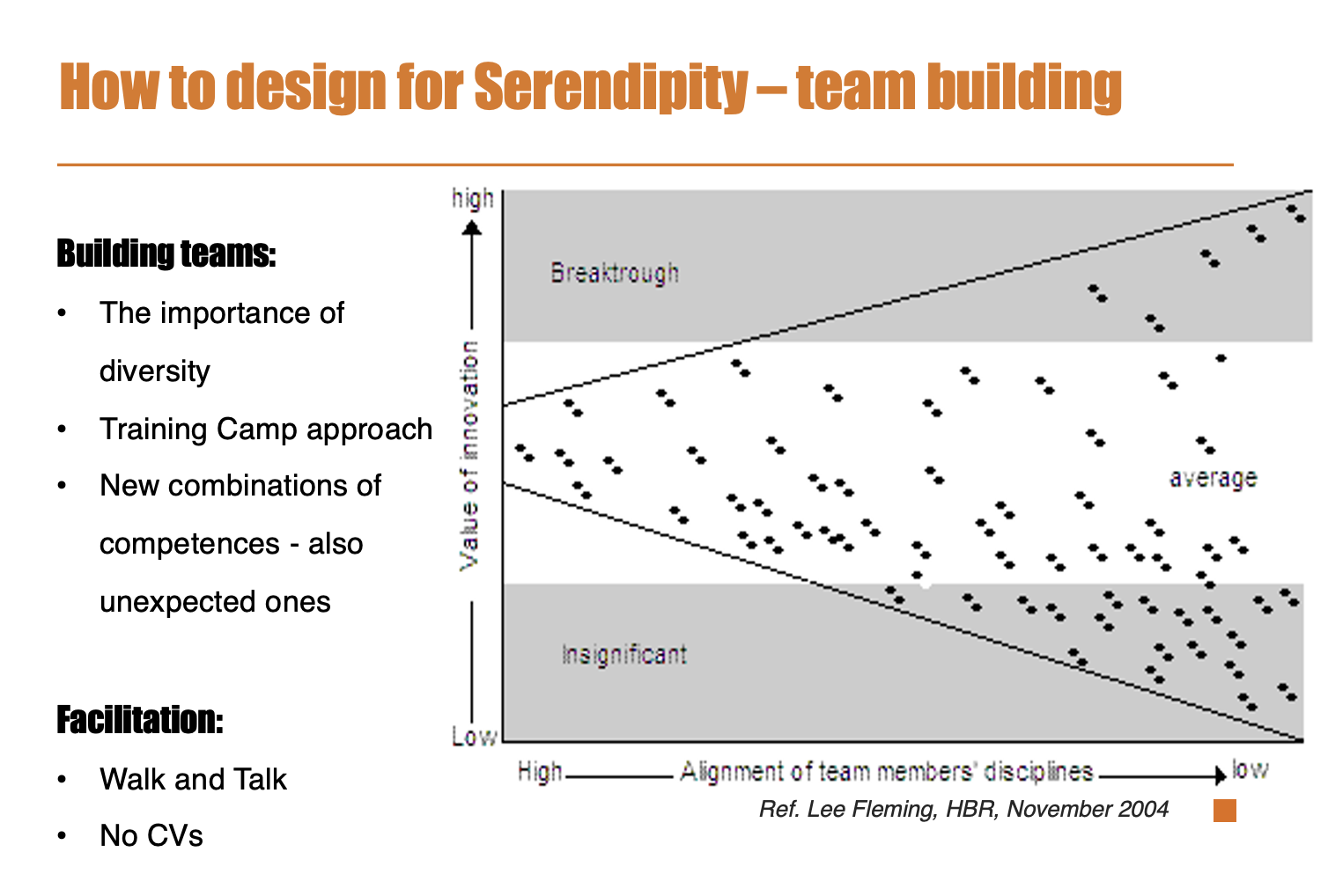
Pentland brought data and social physics to the question of how innovation actually spreads. He demonstrated that the flow of ideas across networks — not just individual brilliance — drives discovery and creativity. When idea exchange is too constrained or too conformist, collective intelligence suffers. The Jester’s contribution here is architectural: designing the conditions under which diverse ideas can meet and combine productively.
Pek van Andel and the Science of Serendipity
Van Andel gave serendipity its most rigorous scientific treatment. He defended it against vague romanticism and showed that certain conditions and attitudes reliably increase the likelihood of valuable unsought findings. His work reminds us that chance favors not only the prepared mind, but the mind that has built the right habits of observation, curiosity, and openness. In Jester terms, he protects and clarifies one of the tradition’s most important tools: the disciplined cultivation of anomaly detection and abductive thinking.
Daniel Kahneman’s Essential Books
Because Kahneman’s work is elementary while crafting 21st-Century Jester archetype and putting together my own legacy, it’s time to open up Kahneman’s books.
His two major books certainly deserve special attention in the times of Postnormal Era!
Thinking, Fast and Slow (2011)
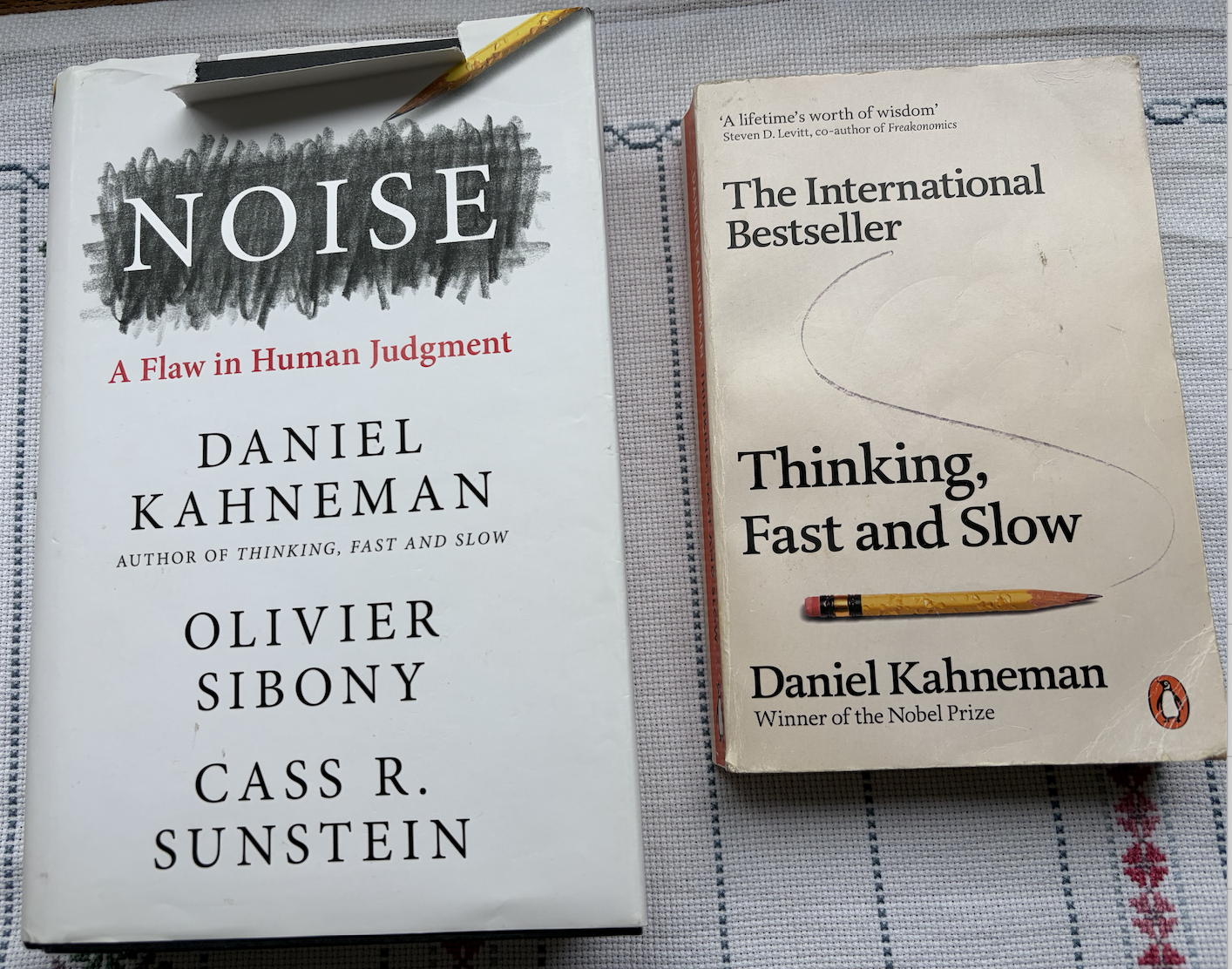
This is the book that brought behavioral economics and cognitive biases into mainstream conversation. Kahneman shows, with remarkable clarity and experimental evidence, that we are not the rational actors we imagine. We are storytellers who are systematically overconfident, loss-averse, and blind to our own blind spots. The book is both humbling and strangely empowering: once you understand the machinery, you can begin to work with it instead of being ruled by it. For anyone interested in better decision-making — whether in business, policy, investing, or personal life — this is foundational reading.
Noise: A Flaw in Human Judgment (2021, with Olivier Sibony and Cass Sunstein)
Where Thinking, Fast and Slow focused on the predictable biases inside one mind, Noise examines the messy reality of professional judgment across many minds. The core insight is simple but powerful: in almost every domain where we expect consistency — medicine, law, hiring, forecasting — there is far more random scatter than we realize. Two doctors can reach opposite conclusions about the same patient. The same resume can be rated excellent or poor depending on who reads it and even the time of day. This “noise” is costly, unfair, and largely invisible until someone measures it.
The book does not stop at diagnosis. It offers “decision hygiene” — practical techniques that organizations can use to reduce unwanted variability: structured interviews, independent judgments followed by aggregation, simple algorithms as noise-reduction tools, and structured processes like premortems. It is the Jester at his most constructive: exposing the problem clearly, then handing us better tools.
The Deeper Parallel: Choosing the End
Koestler and Kahneman both spent their lives helping others see more clearly and judge more wisely. Both ultimately applied that same clarity to the question of their own exit.
Koestler, facing progressive illness, chose a planned departure with his wife rather than endure the process of dying he feared more than death itself. Kahneman, still intellectually sharp and emotionally content at ninety, acted on a conviction he had held since his teenage years: that the miseries and indignities of the last years of life are often superfluous. He traveled to Switzerland, said his goodbyes, and died on his own terms.
One can debate the ethics and circumstances of these choices. What is harder to dispute is that both men refused to let biological or institutional randomness dictate their final story. They exercised the very judgment and autonomy their life’s work had sought to understand and strengthen. In that sense, their endings are not an exception to their philosophy — they are among its most consistent expressions.
#Recommended Books from This Tradition
If you want to explore these voices yourself, here are the essential starting points:
- Daniel Kahneman – Thinking, Fast and Slow (2011) — The clearest map we have of how our minds actually work (and mislead us).
- Daniel Kahneman, Olivier Sibony & Cass Sunstein – Noise (2021) — Why expert judgments vary so much more than they should, and what to do about it.
- Arthur Koestler – The Act of Creation (1964) — The classic exploration of bisociation and the creative leap (demanding but rewarding).
- Gary Klein – Seeing What Others Don’t (2013) — How real insight emerges in high-stakes, uncertain environments.
- Alex Pentland – Social Physics (2014) — How the flow of ideas across networks drives (or stifles) innovation.
- Pek van Andel – Anatomy of the Unsought Finding (1994, research article) — The most rigorous scientific treatment of serendipity available, follows truthfully the elementary lessons learned from the original Peregrinaggio fairytale.
A Living Tradition
These five thinkers do not offer easy answers. They offer something more valuable: better questions, sharper tools, and a clearer view of the machinery inside our own heads and between us. Whether through bisociation, noise reduction, frame shifts, idea flow, or disciplined authentic serendipity, they help us see what we would otherwise miss — and act more wisely because of it.
That two of them ultimately turned that same clarity toward the question of their own ending feels, to me, less like coincidence and more like the tradition completing itself. They did not merely study judgment. They exercised it — all the way to the end.
And perhaps we need a lighter closing, so let’s borrow a final piece of wisdom from Arthur Koestler:
“The more original a discovery, the more obvious it seems afterwards.”
That is true in this context as well. Once these five thinkers are seen together as a circle, the connection almost feels self-evident — but only afterwards.