Photo courtesy Spaces 1/2009:
Peripatos – the Walk & Talk artery of netWork Oasis with its embedded GLOW competence platform touch screen, two beautiful frescos on top of the wall
“The King arrived. Peripatos fell silent. The soul of Oasis left the building.”
netWork Oasis is the project of my life. It always will be. More than twenty years after our kick-off event in Joensuu, I can finally see that clearly. The book I finished writing few weeks ago became the unexpected vehicle that let me process what happened there. Writing it was not just documentation — it was a healing act, a chance to look back and understand how those events quietly transformed me.
The final trigger came when I re-read Arthur Koestler’s The Act of Creation (1964). Fifteen years earlier I had raced through it, ticked the “read” box, and forgotten it — exactly the kind of mechanical checklist that Megan Reitz and John Higgins warn against: “You can tick every box on the checklist and still miss the future.”
This time the book hit differently. I was struck by Koestler’s three archetypes of creativity — Jester, Sage, Artist — and especially by his concept of bisociation. But what truly electrified me was the window he opened into the daily habits and inner lives of the greatest inventors and thinkers. The Jester dimension felt almost mystical. I dove deeper, interviewed the world’s leading experts on the subject, and began shaping what I now call the 21st-Century Jester — a modern archetype of courageous, anomaly-detecting sensemaker.
That research gave me the energy not only to start the book but to finish it with a print-ready manuscript. Only later did I realise that writing it was a necessary step in a much larger journey I have come to call the Cognitive Pilgrimage.
From Peregrinaggio to Cognitive Pilgrimage
In my forthcoming book Serendipity Unleashed – Hidden Wisdom of the Jesters I compare two fundamentally different kinds of journey.
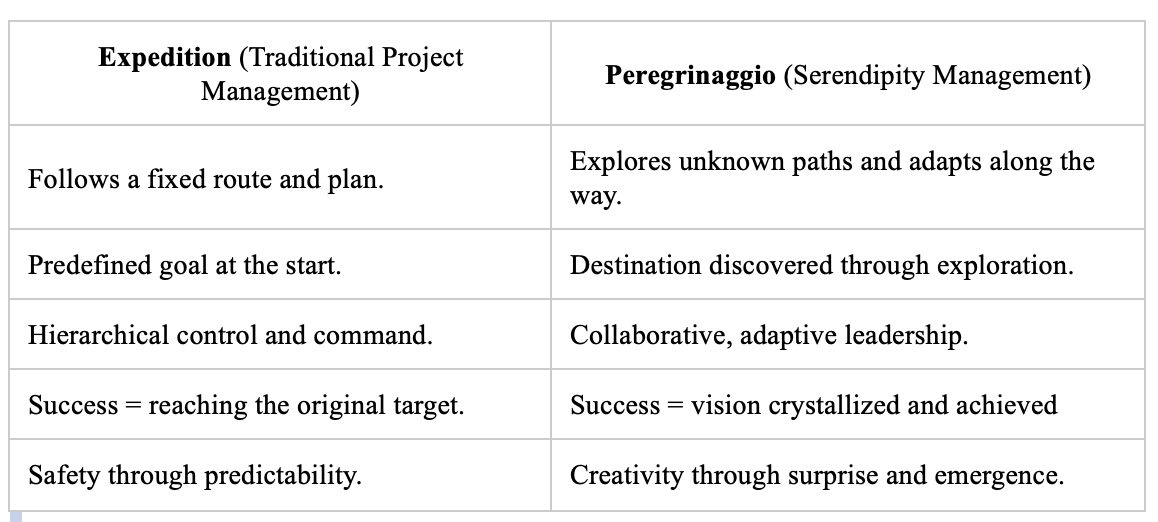
Traditional project management is an Expedition: fixed route, predefined goal, hierarchical control. Success equals hitting the original target on time and on budget. Recommended when constructing a bridge.
Serendipity Management, by contrast, is a Peregrinaggio — the open, virtue-seeking wandering of the three princes of Serendip in the ancient fairy tale that gave us the word “serendipity.” They had no map and no fixed destination. Their journey was a school of wisdom. Through jester-like observation, detection of anomalies, and abductive reasoning they discovered their deeper destiny and became wise rulers. Recommended for creating something unique.
While writing those lines I realised the Peregrinaggio is not merely a historical metaphor. It is a living cognitive practice on personal level. I therefore give it a new, modern name here: the Cognitive Pilgrimage.
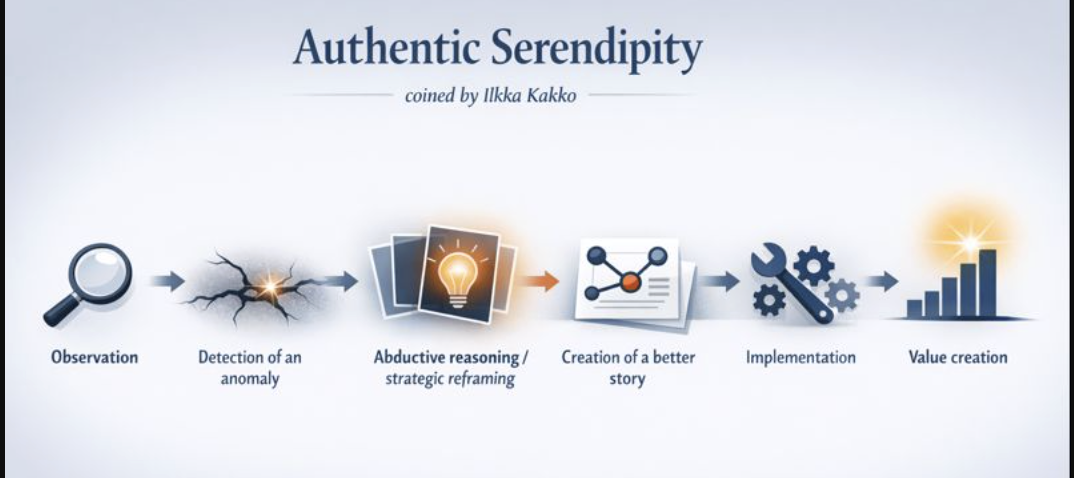
This pilgrimage is the exact mirror image of the six-step Authentic Serendipity process I developed during the research for the book. It is not random drifting. It is a disciplined cognitive journey built on deep observation, anomaly detection, strategic reframing, and the creation of a better collective story.
The Real Story: netWork Oasis and the Dump King
We designed netWork Oasis as a living prototype of exactly that kind of environment — a space where both Walpolean and Authentic Serendipity could flourish. It worked. The space won awards. Visitors came from around the world. In 2008 the Finnish Chapter of the International Facility Management Association named me Facility Manager of the Year for the innovative environment we had created. I proudly hung the certificate on my wall.
The very next day the newly appointed CEO of the science park — the man I still call the Dump King — ordered it removed. Almost simultaneously he dismantled the team of five dedicated professionals who had been instrumental in Oasis’s launch. I left soon afterwards and continued my journey as an entrepreneur.
That single absurd act (what my friend Charleen Johnson would instantly tag as #absurdity) symbolised everything. The king could not tolerate visible proof that success had emerged from a method that was not his own. The legendary “Not Invented Here” syndrome, amplified by narcissistic leadership, revealed its destructive power. Within months the soul of Oasis was gone. The physical space remained, but the spirit had escaped.
This was not zemblanity — mere bad luck dressed up in clever language. This was Serendipity Lost: the deliberate destruction, at the final moment of value creation, of something that had been perfectly incubated.
Why This Still Matters in 2026
Most innovation programmes today still operate in Expedition mode — fixed plans, command-and-control, premature closure. They keep wondering why genuine breakthroughs refuse to appear and why the most creative people quietly leave.
The Cognitive Pilgrimage offers a different path. Otto Scharmer’s U-Theory works beautifully when applied properly, but the pre-phases Co-sensing and Co-presensing require special attention. We started to call that Network Incubation — the deliberate creation of conditions where observation, anomaly detection, and abductive reasoning can do their quiet work. It is not about forcing outcomes. It is about creating the environment where wisdom and value can emerge through collective intelligence.
Three Hard Lessons
- The Dump King Syndrome One person with unchecked power and zero jester-like humility can destroy years of carefully incubated collective intelligence in a matter of months. Once a breeding environment exists, it must be protected — or it will die.
- Authentic Serendipity Can Still Be Ruined in the Final Phase You can follow every step of the process flawlessly — open observation, anomaly detection, strategic reframing, creating a better story, implementation — and still watch the entire journey collapse at the exact moment when it should scale. The magic dies right when it should multiply.
- Zemblanity Is Not the Opposite of Serendipity — Serendipity Lost Is Zemblanity is just bad luck with a fancy name. Serendipity Lost is something far more traumatic: you saw the promised land, you lived in it for a while, you tasted the magic — and then it was deliberately taken away. Not by accident. By rigid, tone-deaf control. That pain is deeper because you had full agency in the creation, yet none in its destruction.
Lessons for Leaders and Organisations Today
- Protect the breeding environments once they exist. One Dump King can erase years of work in months.
- 21st-Century Jesters are not optional — they keep the collective Cognitive Pilgrimage alive.
- Survivorship bias hides the 999 invisible Oases. The real wisdom often lives in the beautiful failures that almost made it.
- Serendipity Lost is recoverable. The incubation period can be twenty years — but when the next chapter finally arrives, it arrives stronger.
- Stay in the open phase longer. That is where destiny is discovered, not invented.
The physical netWork Oasis in Joensuu still stands, but it is only a façade. The certificate came off the wall. The spirit escaped.
Today that spirit travels through every organisation that still has the courage to practise the Cognitive Pilgrimage instead of marching in Expedition formation.
My Personal Message — Twenty Years Later
Writing this today, almost twenty years after the destruction of netWork Oasis, I can finally say it out loud.
It was not just a professional setback. It was a deep, personal misfortune — the kind of wound you don’t talk about because the pain is mixed with embarrassment and endless “what ifs.” It took a full twenty years of quiet incubation before I was ready to process it properly. That processing happened while I was writing Serendipity Unleashed. Only then could I turn the scar into strength.
Today I am wiser, calmer, and — paradoxically — more convinced than ever that the 21st-Century Jester is not optional. The ideas born in Oasis did not die. They simply escaped Joensuu and are now travelling the world.
Serendipity Lost is recoverable.
Respect serendipity. Trust your inner Jester.