Why I No Longer Think Facilitation Is Enough
A few days ago, while revisiting my old presentation materials, I stumbled across a slide I had presented at the Serendipity Forum organised by Zona Space in St. Petersburg in 2013.
Looking at it after thirteen years produced an unexpected reaction.
The graph still felt remarkably accurate, but those at that time brilliant solutions didn’t any more feel so appealing. Now I finally — after thirteen years — see this more clearly and understand what has changed and why.
That is one of the privileges—and occasional embarrassments—of spending decades thinking about the same question. Sometimes an old idea survives remarkably well.
Sometimes you discover that you had diagnosed the problem correctly but misunderstood its solution. This was one of those moments.
A Slide That Refused to Grow Old
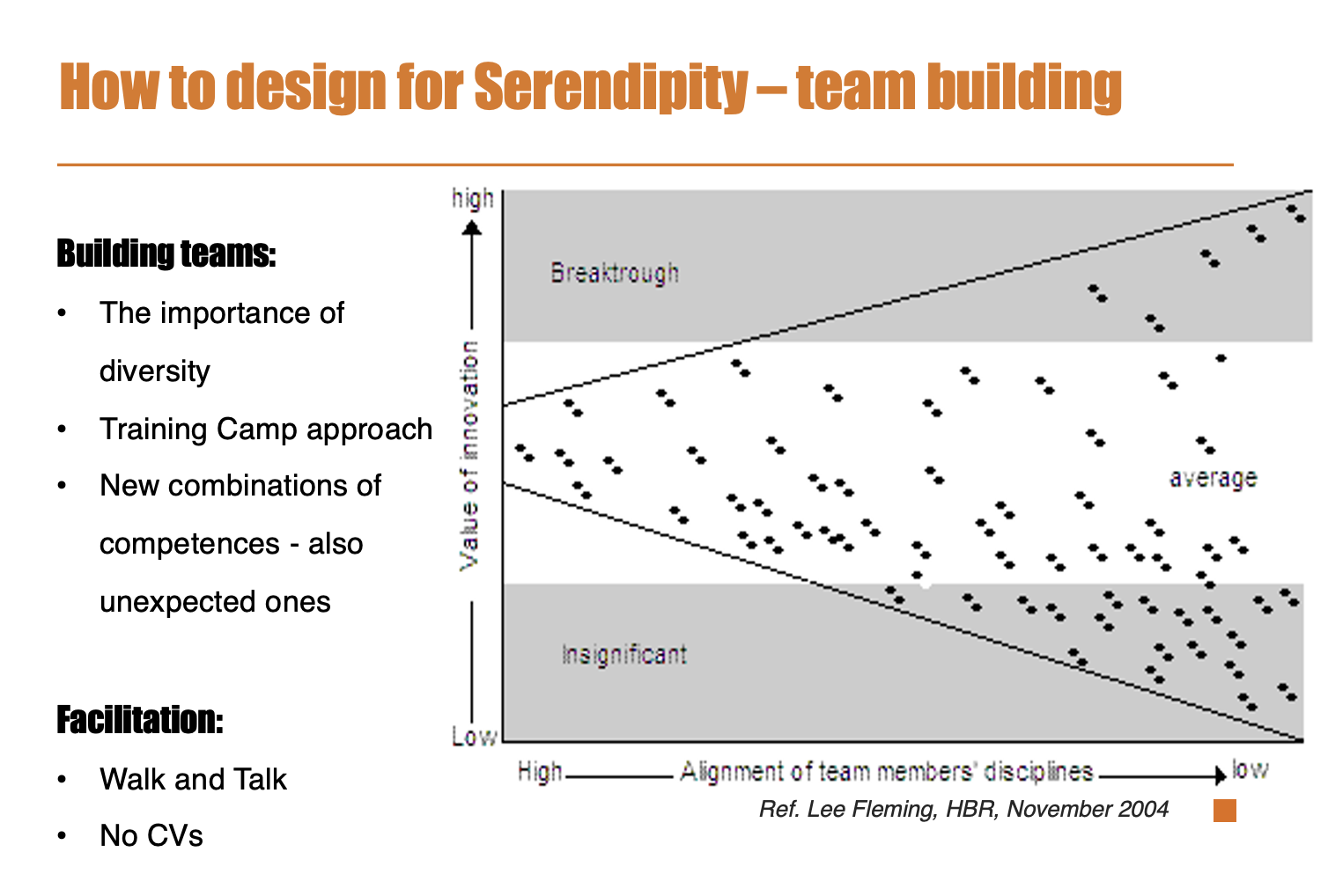
The figure below was my attempt, back in 2013, to explain what happens when the disciplinary alignment within a team gradually decreases.
As diversity increases, the range of possible outcomes widens dramatically.
Incremental improvements remain possible, but so do genuine breakthroughs.
At the same time, the lower end of the distribution sinks just as dramatically. More weak ideas emerge. More misunderstandings appear. More seemingly promising paths turn out to be dead ends.
The graph suggests something that is rarely acknowledged. Diversity is not a free lunch. As the possibility space expands, breakthrough potential increases— but the average outcome will even deteriorate unless organisations possess the capability to convert diversity into collective intelligence. As the possibility space expands, so do volatility, uncertainty and complexity. At the same time, organisational noise amplifies ambiguity, making it increasingly difficult to distinguish meaningful signals from mere distractions. Together, these are precisely the conditions captured by the acronym VUCA.
Have we unintentionally been importing VUCA into our own organisations in the hope of becoming better at coping with an increasingly VUCA world?
Diversity undoubtedly expands the possibility space. That is one of its greatest strengths. But the same expansion also increases organisational noise, making it harder to distinguish genuine signals from distractions.
We celebrate the upside of diversity. Much less attention has been paid to its cognitive costs.
Looking back today, I realise that the slide captured something fundamental.
It visualised what I now call the Diversity Paradox.

Diversity Is Not the Destination
Every organisation says it wants diversity. DEI initiatives, inclusive recruitment policies and multidisciplinary teams have become almost obligatory elements of modern management. Yet diversity is too often treated as an end in itself — which it is not.
Diversity is merely the starting point. Without the cognitive infrastructure needed to transform diverse perspectives into shared understanding, organisations simply replace conformity with confusion.
That may sound provocative. Yet it is precisely what decades of research suggest.
Lu Hong and Scott Page demonstrated that groups of similarly talented people often make remarkably similar mistakes. Their intelligence becomes correlated. Their blind spots become shared.
Lee Fleming approached the same challenge from another direction. Breakthrough innovations emerge from rare combinations of previously disconnected knowledge domains. Diversity expands the search space and increases the probability of extraordinary outcomes.
Both are correct — but relying only on their arguments only, we may in fact forget the other side of the coin.
The same diversity that creates breakthrough opportunities also creates dramatically more organisational noise.
Kahneman Completed the Picture
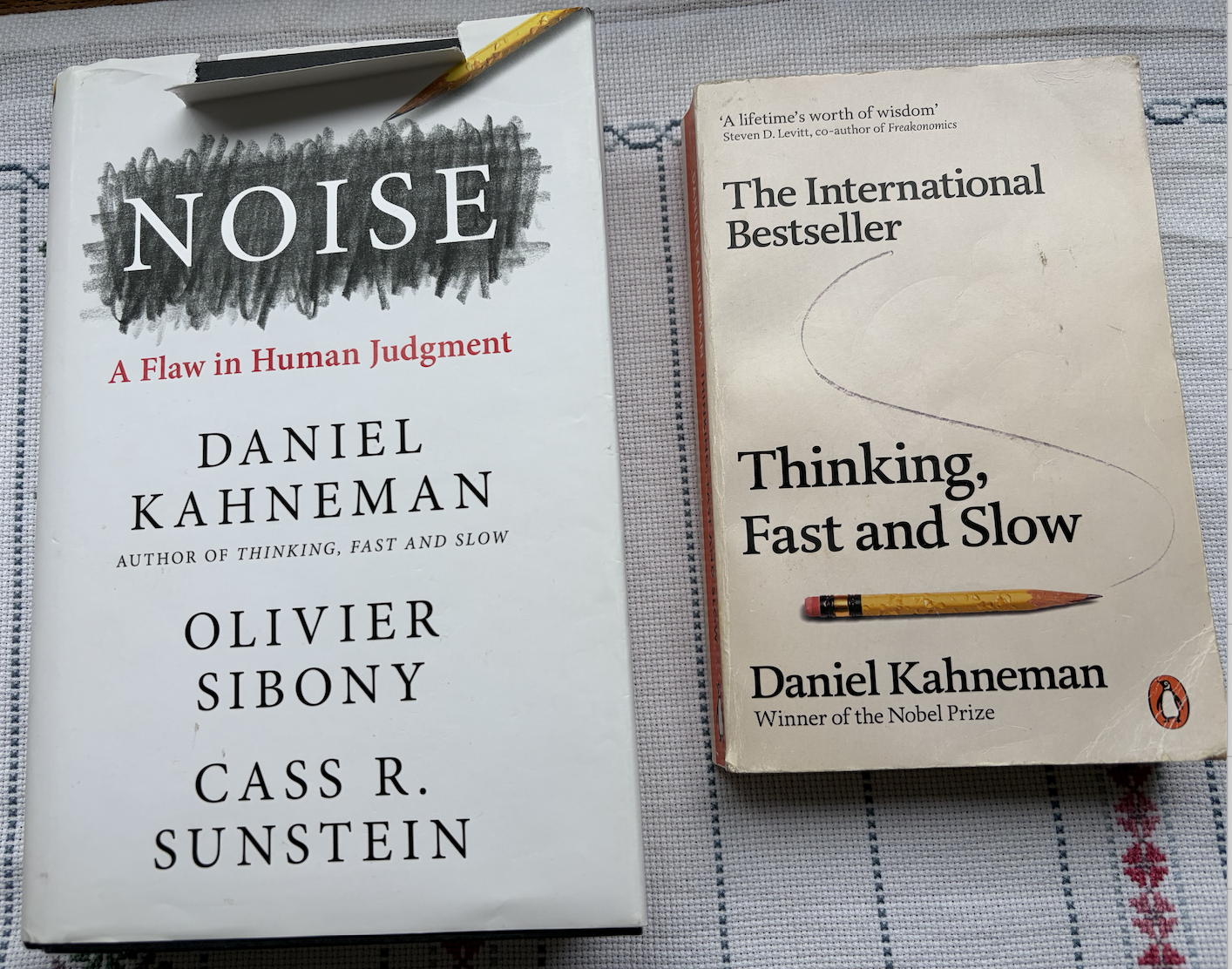
When Daniel Kahneman, Olivier Sibony and Cass Sunstein published Noise in 2021, another piece of my puzzle finally fell into place. They distinguished two fundamentally different sources of error. Bias systematically pushes judgement in one direction. Noise scatters judgement in many directions. Most organisations spend enormous effort eliminating bias. Far fewer recognise noise as an equally dangerous organisational problem.
Yet diversity naturally amplifies noise, because different disciplines notice different things. What might be irrelevant from a certain perspective might be elementary from the other side.
Different professions value different evidence. Different experiences generate different interpretations. Communication becomes harder. Mental models diverge. Facilitation might become more challenging – but all this leads to one key issue:
Does all this enable better collective sensemaking?
The organisation gains possibilities. It also gains uncertainty and ambiguity.
That is the Diversity Paradox:
The same diversity that creates the possibility of breakthrough simultaneously increases the probability of insignificance.
Looking Back, My Own Solution Was Incomplete
This is where my 2013 slide suddenly became interesting for an entirely different reason.
On the right-hand side of the slide I had listed practical recommendations.
Walk and Talk in groups of three. Training Camps with strict “No CVs”-rules. Fostering unexpected combinations of competences. Believing in the magic of (Walpolean) serendipity.
At the time I believed these were the solution, today I see them differently.
They were valuable and encouraged encounters.
They reduced unnecessary barriers between people and expanded the opportunity space.
But they did not solve the deeper organisational challenge.
They helped organisations create more conversations. But they did not significantly improve their ability to distinguish meaningful conversations from distracting ones.
They expanded the cone but they did not teach organisations how to navigate it.
In retrospect, I had diagnosed the paradox correctly. I simply had not yet discovered the organisational capability required to address it.
The Missing Piece Took Me Thirteen Years to Find
Writing Serendipity Unleashed became something I had never anticipated.
I thought I was writing a book about serendipity. Instead, I found myself slowly uncovering a much larger organisational challenge. The missing ingredient was never another creativity technique or another facilitation method or another innovation framework.
The missing ingredient was an entirely different kind of organisational capability.
What organisations increasingly need is cognitive infrastructure.
Beyond Frameworks
Throughout my entire book project I described my Smile in Mind – model as a framework.
I no longer think that description goes far enough, because frameworks organise activities. But infrastructure enables entirely new capabilities. Digital infrastructure enables information to flow – physical infrastructure enables people and goods to move.
Cognitive infrastructure enables organisations to think together. It enables people with radically different experiences to transform diversity intocollective intelligence instead of collective confusion.
It creates the conditions for abductive reasoning:
Collective sensemaking.
Constructive contradiction.
Meaningful dialogue.
Reflection.
Curiosity.
And perhaps most importantly it allows you to follow the Authentic Serendipity framework and help your organisation:
to distinguish relevance from salience.
to create a better story!
The New Bottleneck
Modern organisations are no longer constrained by information.
Nor by ideas. Nor increasingly by artificial intelligence.
They are constrained by judgement. AI can generate thousands of possibilities in seconds. Diverse teams can generate hundreds more.
The bottleneck has shifted. => The real challenge is deciding which possibilities deserve attention.
Salient things may draw the attention, but relevant things change the future of your organisation.
The two are rarely the same.
Without cognitive infrastructure, organisations systematically reward what is loud rather than what is important.
Noise wins and insight disappears unnoticed. Absurdities will prevail and keep on transforming to organisational habits. Originality vanishes. The meetings are conducted technically perfectly.
=> this all leads to a situation which Charleen Johnson – a distinguished business transformation leader calls The Age of Absurdity.
Every Infrastructure Needs a Guardian
Every important infrastructure requires stewardship, physical infrastructure requires maintenance, digital infrastructure requires cybersecurity and should secure relevant information flows
Financial infrastructure requires governance.
Cognitive infrastructure also requires a guardian.
This is where another idea finally fell into place during the writing of Serendipity Unleashed.
The ancient court jester was never merely an entertainer. The jester protected something every complex decision-making system desperately needed: alternative interpretations, constructive contradiction, permission to question certainty, the courage to notice absurdity before everyone else explained it away.
Modern organisations have largely eliminated that institutional role — ironically, they now need it more than ever.
The reason is surely not that people have become less intelligent, but because they have become overwhelmed by complexity and ambiguity.
The 21st-Century Jester
The role of the 21st-Century Jester is not to tell the truth! Who’s sub-truth is it anyway? Customer’s, mid-management’s, investor’s or CEO’s?
Nor is his role anymore to challenge authority like in ancient courts. Modern organisations have infra and processes for that already established.
The deeper purpose of 21st-Century Jester is organisational, his main responsibility is to safeguard the organisation’s ability to think – to improve collective sensemaking!
The Jester help people to discover meaningful anomalies before they disappear beneath routine and to challenge flawed assumptions before they harden into dogma.
He is there to introduce productive contradictions and to create space for abductive reasoning asking those elementary “What if….” questions.
21st – Century Jester is an organisational necessity to protect curiosity from premature certainty.
He is the one who continuously asks the question that matters most:
“What if … this is merely salient—or is it genuinely relevant?”
The 21st-Century Jester is the guardian of the organisation’s cognitive infrastructure. His role becomes elementary the deeper we dive into the Postnormal Era.
The urgent challenge will be where do we find these archetypes!