Last week I spent 45 minutes on a wonderful Google Meet with Susan Hilbolling .
Susan, together with Pernille Smith, has recently published a groundbreaking new paper in Strategic Organization (2025): “Demystifying serendipity: How mundane practices enable the identification and pursuit of extraordinary discoveries.”
Our conversation was deeply inspiring and validating for me — because for a long time I have been arguing exactly what their research now demonstrates with rigorous, real-time evidence.
This research changes the game
Smith and Hilbolling did something radical: a 5-year real-time longitudinal study inside a major pharmaceutical company participating in a large pre-competitive international research consortium. They followed events as they actually unfolded — not how people later remembered or retold them after the successful outcomes were known.
As Susan shared with me, their original purpose was not to study serendipity at all. As they write in the paper: “While our original research focus was to unpack knowledge integration practices, not unexpected outcomes, our attention was drawn to them as they began to emerge…”
What an insight – the most valuable serendipity research for a long time – turns actually out to be a serendipitous finding!
And that single methodological shift makes all the difference. No need for more polished retrospective hero stories. No more “one day Fleming noticed the mold and — boom — penicillin.” No more romantic “Steve Jobs skipped a meeting and met his future wife” LinkedIn fairy tales. No more serendipity researchers focused on studying already published serendipity research articles.
Why retrospective stories have been misleading us
Almost all existing serendipity literature (and pretty much every motivational post you see on LinkedIn) relies on retrospective accounts. Once the lucky outcome is known, our brains do what they always do: “Hindsight leads us to rationalize past events and actions and lead us to see processes as logical paths, when they were in fact constitutive of a series of unexpected circumstances.” — Smith & Hilbolling (2025), citing Reinecke & Ansari (2017)
This is hindsight bias in action. Combined with survivorship bias, it creates the perfect illusion that serendipity can be fabricated by romantic retrospective stories forgetting all unsuccessful cases from similar actions. The messy, effortful, distributed reality disappears. We only hear the glamorous exceptions.
Smith & Hilbolling deliberately chose a real-time approach precisely to escape this trap. What they discovered is far more useful — and far less romantic: the practices leading to breakthrough discoveries are remarkably mundane and ordinary.
Serendipity is work.
They call it “serendipity work” — a repeating bundle of four very ordinary, effortful social practices that unfold over time across multiple episodes:
- Deep-diving — immersing yourself deeply into a new topic or problem (often starting as routine task-related work).
- Listening in — paying broad, peripheral, unfocused attention to what’s happening around you (the “ambient awareness” of the periphery).
- Connecting — linking new insights to your own existing domain knowledge and strategic context.
- Implementing — actively turning those insights into action, resources, and organizational change.
These practices usually begin as part of planned, everyday objectives. Over time — sometimes spanning years — they generate surprising discoveries that can be shaped into real strategic value if the actors keep the cycle alive.
The paper includes two detailed vignettes from the consortium. In one, a seemingly low-priority work package on patient-reported outcomes (PROs) evolved through regulator interactions into a major strategic opportunity for the company — not because of a sudden flash of genius, but through repeated cycles of deep-diving, listening in, connecting, and implementing. In the second vignette, a promising insight about patient involvement never materialized because the implementing step never happened.
Both stories show the full, messy reality — including the paths that don’t lead to glory.
This directly validates the vocabulary I’ve been championing
In my earlier #SerendipityUnleashed essays I argued three core points:
- “Unexpected” is the wrong word for defining serendipity. It scales with ignorance — the less you know, the more everything feels unexpected. True serendipity is unanticipated even to experts.
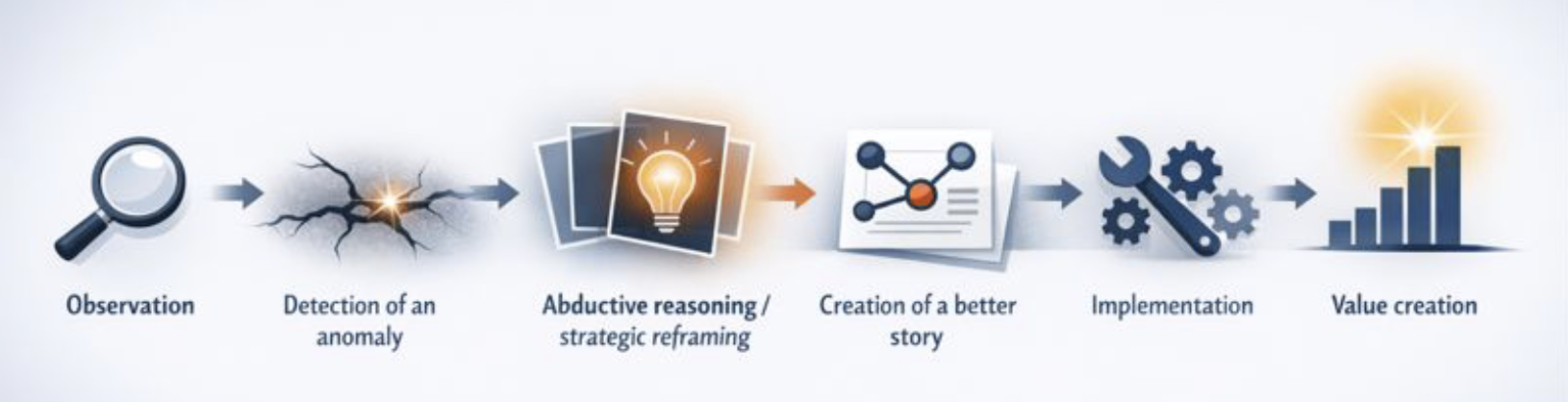
- Serendipity requires a forgotten vocabulary: unanticipated + anomalous + strategic (building on Robert Merton’s classic framework and Pek van Andel’s research).
- We must stop glorifying the “lucky exception” and instead respect the disciplined process.
Smith & Hilbolling provide powerful empirical backing for all three:
- They repeatedly describe the discoveries as unanticipated (even within a highly planned consortium).
- The discoveries were anomalous — they fell outside the original grant agreement and planned objectives.
- They only became strategic through deliberate connecting and implementing work that turned potential into value.
Serendipity, they show, is not passive magic that happens to you or in your company. It is an active, distributed and collective social process that companies can cultivate through mundane, repeatable practices.
The bigger picture
The romantic stories feel good. They sell books, TED Talks, and LinkedIn carousels. But the real work actually works. Unfortunately, it’s boring. And conducting research in live conditions for long periods of time requires resources and motivation – and it’s difficult technically.
The article of Hilbolling & Smith elementary for the future of serendipity research — it demystifies serendipity without killing its wonder. It shows that extraordinary discoveries emerge from ordinary organizing — if we create the conditions for deep-diving, listening in, connecting, and implementing to happen repeatedly over time.
I am delighted about the encouragement that Susan and Pernille’s work is giving me. I will continue to promote my Authentic Serendipity framework in the upcoming months — keep on the channel to follow!
What about you? Have you ever experienced serendipity that only made sense in retrospect — or have you caught yourself doing “serendipity work” in real time (deep-diving, listening in, connecting, implementing)?