This is the first essay of Serendipity Unleashed series which covers the final part of the book – the real lessons learned during my consultancy and how they are forming the foundation of my Smile in Mind framework. In this first essay we reveal the most intriguing chain of events in the netWork Oasis history. I want to describe it here because it shows how great ideas just emerge parallel – this happened both in US and in Finland – separately.
When we designed on conceptual level netWork Oasis and in the process crafted the Oasis Way of Working 2003-2004, we had never heard of Otto Scharmer’s and Peter Senge’s U-theory!
What we had was a challenge: how to create an environment where genuinely new ideas could emerge from diverse people working together under uncertainty.
Only later, when Otto Scharmer’s (co-authored with Peter M. Senge, Joseph Jaworski, and Betty Sue Flowers) book Presence: Human Purpose and the Field of the Future was published 2004 and I read it later that year, I experienced a rare moment of professional recognition. What we had lived through—often with uncertainty, tension, and no clear roadmap—was described there as a coherent process. The alignment was striking.
This realization led us to articulate the connection more explicitly in our academic work and we presented our paper in June 2007 within ICE conference proceedings in Sophia Antipolis, France. Fortunately, later on I had also the opportunity to discuss these parallels directly with Otto Scharmer during his visit to Helsinki in 2008 [1). In that conversation, the similarities were not only acknowledged—they were validated.
What Scharmer describes is not a linear method but a movement—a shift in how individuals and groups relate to reality, to each other, and to the future that is trying to emerge. The process moves from observing and downloading existing patterns, through deeper sensing and reflection, into a state where new possibilities can be perceived, and finally into action through experimentation and prototyping. The scheme of U-theory below.

At its core, this movement requires more than tools or structures. It requires a shift in the inner condition of participants: an openness of mind to see differently, an openness of heart to connect, and an openness of will to let go of preconceived outcomes and allow something new to take shape.
What matters, therefore, is not the sequence of steps, but the shift in awareness they enable.
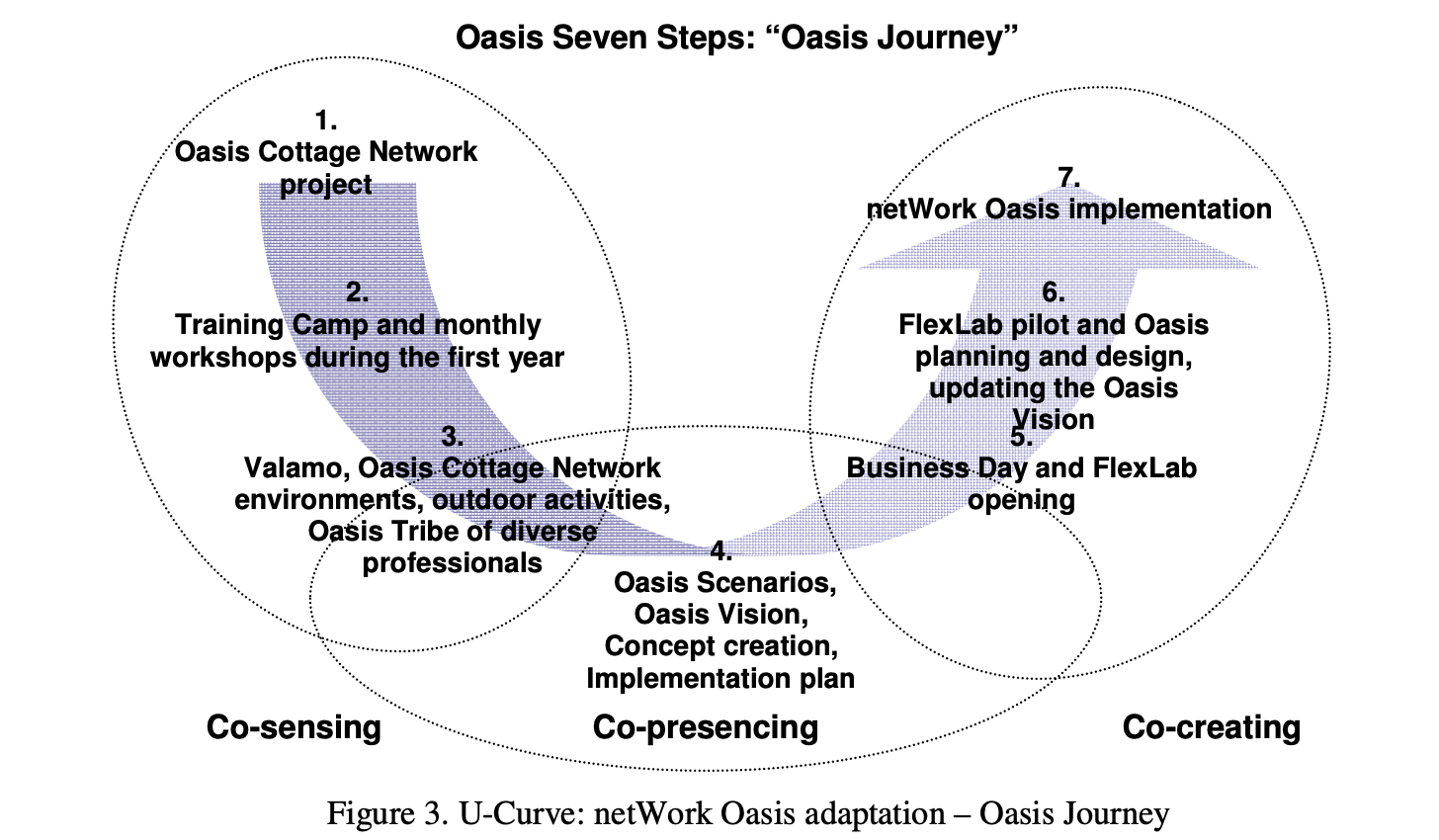
The Oasis Way of Working did not emerge from theory. It was developed through practice—over several years of experimentation, facilitation, and real interaction between people from different backgrounds. Only later did we recognize that this journey followed a pattern remarkably similar to what Scharmer described.
In the early stages, what we now understand as co-sensing took place through the Training Camp approach and subsequent collaborative activities. Diversity was not only present but actively engaged. Trust began to form, and unexpected connections emerged between individuals who would not normally have met. This phase created the conditions for everything that followed.
The most demanding phase was what Scharmer calls co-presencing. Here, progress was not linear. There was ambiguity, tension, and at times a sense of being stuck. The temptation to move quickly into action was strong, yet the real work required staying with uncertainty long enough for deeper insight to emerge. This phase proved to be the least supported by conventional tools and the most challenging for participants to navigate. Here is a quote of our academic article:
“The big challenge here was how to manage the diversity and how to keep the shared understanding alive. One of the hardest tasks was how to get the focus towards the actual design and implementation and how to get some results as quickly as possible. The “brainstorming mode” was still on and it was a challenging task to change it via learning journey to piloting activities.”
Co-creation followed through prototyping and experimentation in the FlexLab environment. Ideas were tested in practice, often reshaped through interaction with real users. This iterative process allowed both the environment and the underlying concept to evolve continuously.
The future was not planned in advance—it was discovered through doing.
Importantly, the process did not end there. It repeated itself in cycles, each time deepening the capability of the community and expanding the scope of what could be achieved. What appears as a sequence is, in reality, a living spiral.
This alignment between the Oasis Way of Working and the U-process reveals something fundamental about how innovation actually unfolds in complex environments. It is not a linear progression from idea to execution, but a dynamic movement that requires space, trust, and the ability to remain in uncertainty long enough for meaningful insight to emerge. We did not derive netWorkOasis from Theory U. Theory U gave language to something we had already lived. netWorkOasis was not a case of theory guiding practice— but practice recognising Oasis Way of Working in theory.
Today, organizations are full of frameworks, models, and methodologies. But many of them miss something essential:
Organizations still focus on what to do — instead of how transformation actually unfolds.
The Oasis Journey—and what Theory U helps us understand—is not a method. It is a movement. And movements cannot be implemented. They can only be enabled.
Now Oasis Way of Working forms a solid foundation for our Smile in Mind framework.
Follow us, we will give next week one more great example of the elements of this emergent Smile in Mind framework — an environment where the 21st-Century Jester feels home and can act fruitfully.
And of course the good news: the entire book Serendipity Unleashed – Hidden Wisdom of the Jesters will be published in upcoming weeks!
(1) Otto Scahrmer served as a visiting professor at the Helsinki School of Economics (HSE, which merged into Aalto University in 2010) specifically at the Center for Innovation and Knowledge Research (CKIR).