AI Is Becoming a Commodity. Cognitive Infrastructure Is Still Missing.
AI is rapidly becoming a commodity. But mainly at the level of individual work — writing, coding, producing.
At the same time, organisations face a much deeper challenge: They lack the cognitive infrastructure required for collective sensemaking.
In other words, while individuals are becoming more capable, organisations are not yet becoming better sensemakers under uncertainty.
The Missing Layer: Cognitive Infrastructure
What is missing in most organisational AI discussions is the system that determines how people think together when those individual tools are used.
This is what I refer to as cognitive infrastructure.
Cognitive infrastructure is the combination of conditions, practices, and structural enablers that allow organisations to:
- recognise what matters
- interpret weak and often conflicting signals
- challenge assumptions
- connect seemingly unrelated ideas
- create a better story
It determines whether contradictions between competing subtruths are suppressed or explored. In environments defined by uncertainty and unpredictability speed alone does not create advantage.
Interpretation of various subtruths is essential in creating a better story.
And interpretation is a collective process. What makes it tricky is how to enable the individual perspectives to make a coherent collective sensemaking.
This process is what enables organisations to craft a shared understanding — a working “truth” that guides them through ambiguity and strengthens resilience. This is where most organisations are currently unprepared.
They struggle to navigate the battle of subtruths — and, as a result, fail to create better stories in business plans, marketing narratives, and strategic positioning.
Stanford as an Early Signal
A recent example at Stanford Graduate School of Business provides an interesting signal.
In their course on “AI and human flourishing”, the focus is not limited to tools or technical capability. Instead, it combines interdisciplinary dialogue, experimentation, and reflection. Students are encouraged not only to build, but to interpret. Not only to produce, but to ask what matters.
More importantly, the course brings together individuals from different backgrounds — people who would not normally work together — and places them in a shared environment where ideas can collide and evolve.
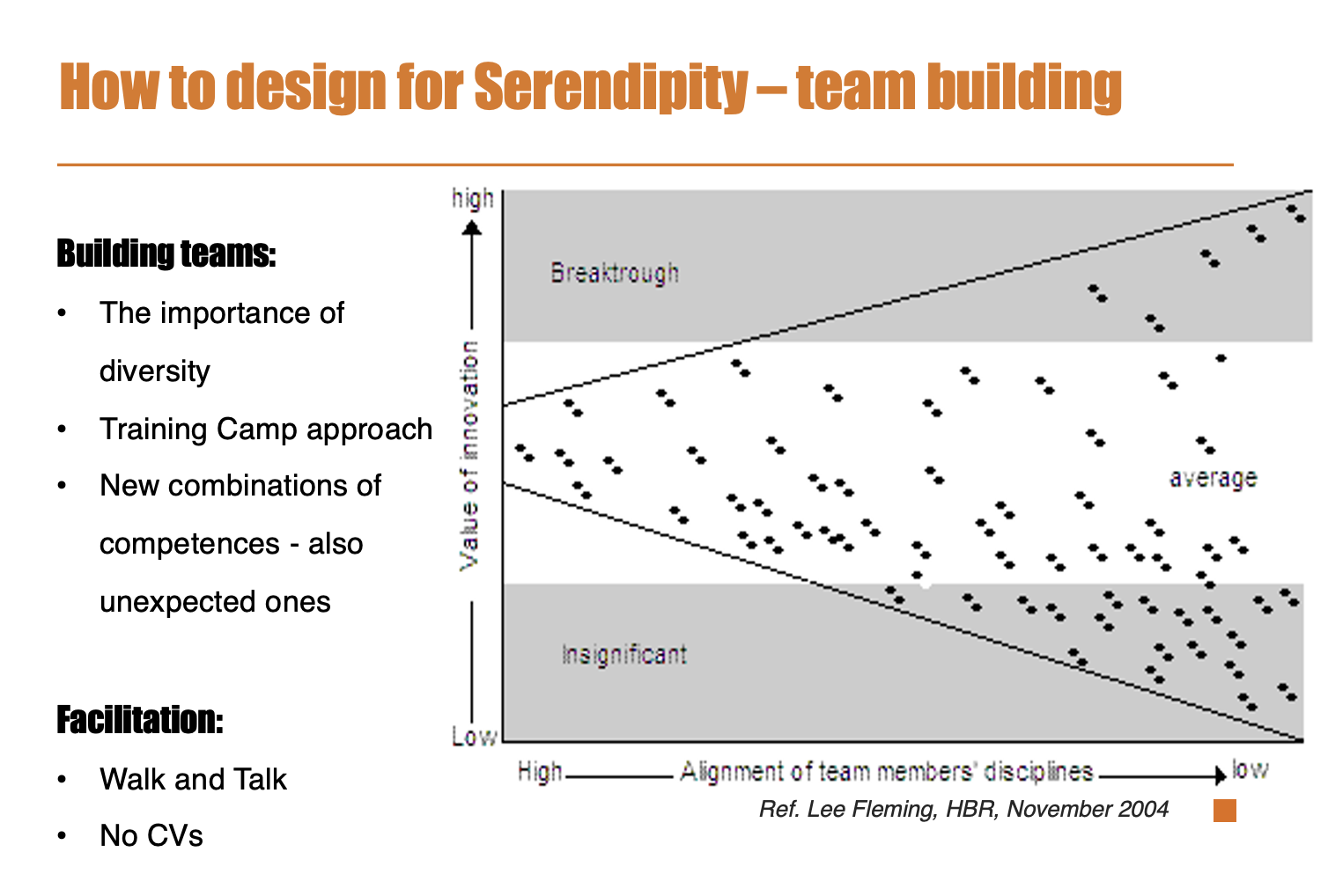
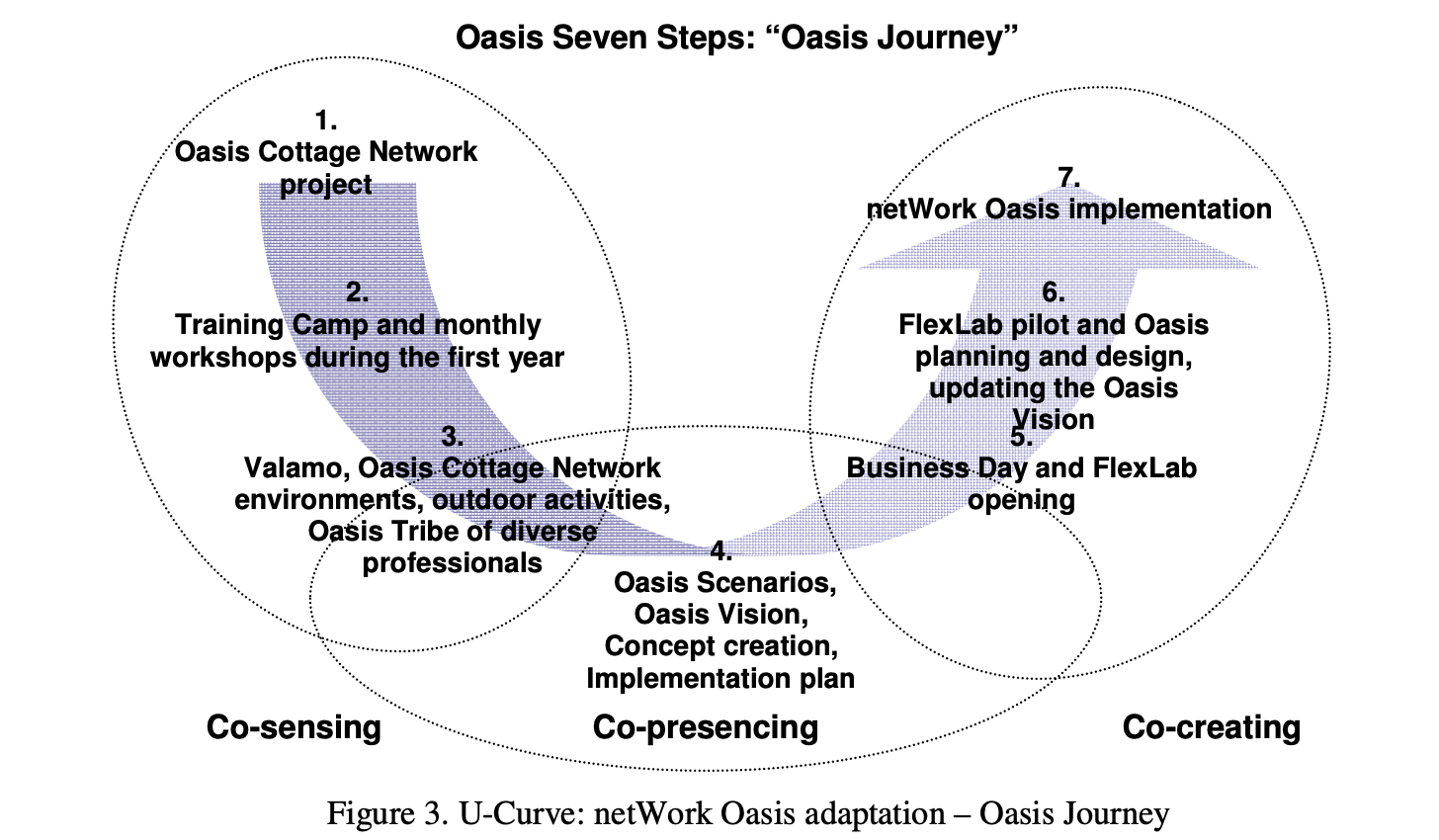
This is not accidental. And it is not entirely new. It closely resembles approaches we have already validated in practice — for example, the Training Camp method used in the netWork Oasis project, and now an essential element of the Smile in Mind cognitive infrastructure..
What Stanford is demonstrating in an academic setting is, in fact, a pattern that can be deliberately designed, replicated, and scaled.
Cognitive Infrastructure Requires a New Archetype
Designing cognitive infrastructure is not only a matter of processes or formats. It also requires a different kind of presence within the organisation. In my forthcoming book, I argue that organisations need a new structural archetype: the 21st-Century Jester. It is an archetype that emerges through authenticity, courage, and cognitive responsibility.
The 21st-Century Jester operates as a guardian and catalyst of cognitive infrastructure, enabling organisations to function as effective sensemakers under uncertainty.
This archetype can be understood through four complementary dimensions:
The Challenger of Power
The Challenger of Power exposes contradictions between competing subtruths — the partial, often conflicting interpretations that exist within every organisation. It ensures that uncomfortable signals are not ignored and that authority does not become insulated from reality.
The Catalyst of Creativity
The Catalyst of Creativity enables bisociation — the productive collision of different frameworks and perspectives — and creative desperation the brilliant coinage by Gary Klein. This archetype keeps Authentic serendipity alive within organisations and creates the conditions for it to emerge naturally.
The Weaver of Meaning
The Weaver of Meaning integrates fragmented insights into coherent narratives — helping organisations move toward a better story.
The Jester as Conscience
The Jester as Conscience safeguards the moral integrity of the organisation. It ensures that efficiency does not override judgment, and that human flourishing remains a guiding principle.
From Archetype to Environment: Smile in Mind
Archetypes alone are not sufficient. They require an environment in which they can operate. This is what I refer to as a Smile in Mind cognitive infrastructure.
A Smile in Mind framework is not defined by visible positivity. It is defined by an internal orientation. Even in demanding and high-stakes situations, individuals are able to operate with openness, curiosity, and reflective capacity. Externally, discussions may appear serious. Internally, the system remains flexible, questioning, and receptive.
In practical terms, Smile in Mind provides the conditions for:
- collective sensemaking
- anomaly recognition
- constructive challenge
- meaningful dialogue
- abductive reasoning
- integration into better stories
It is a practical model for building cognitive infrastructure in everyday organisational life. And it’s just a vision, many elements of Smile in Mind have already been validated in Oasis Way of Working, first in netWork Oasis implementation and later in my consultancies.
From Concept to Scalable Application
The implications of this shift are practical, not theoretical. At Sensemaking Institute, we are currently conducting applied research on how to scale these ideas into the commercial market — translating cognitive infrastructure from concept into operational capability.
This work builds on years of practical experience. Approaches such as the Training Camp model, originally developed and validated in the netWork Oasis project, demonstrate that the conditions for collective sensemaking can be deliberately designed.
Training Camp is not a workshop. It is a structured environment that rapidly establishes the foundations required for teams to function as effective sensemakers under uncertainty — building trust, enabling meaningful dialogue, and accelerating the formation of shared understanding.
This is how cognitive infrastructure becomes tangible. Not as an abstract concept, but as a repeatable and scalable capability.
The Strategic Implication
As AI continues to evolve, access to tools will no longer differentiate organisations and ecosystems.
Everyone will have them. The real differentiator will be how these collectives can think together — make sense — when using these tools.
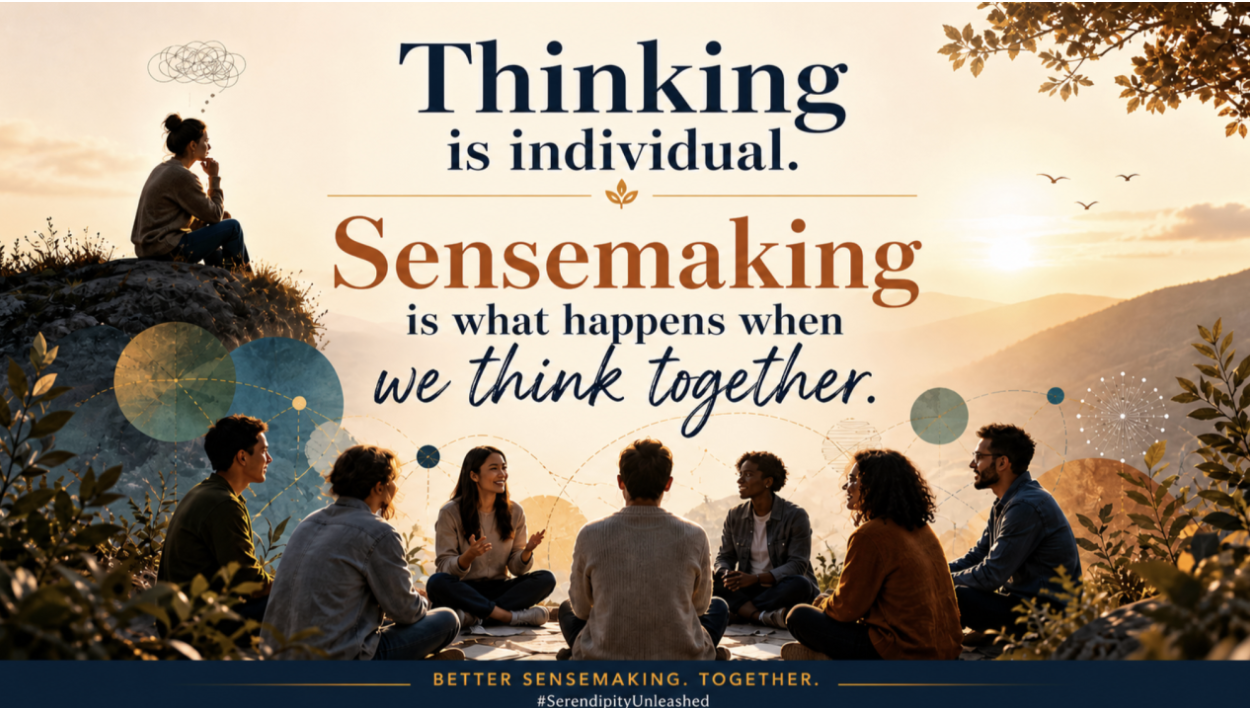
Thinking is individual. Sensemaking is what happens when we think together.
Those who invest only in individual capability will see incremental gains. Those who invest in cognitive infrastructure will fundamentally change how decisions are made, how strategies are formed, and how value is created.
Closing
AI does not eliminate the need for human thinking. It exposes it.
And in doing so, it makes one question unavoidable:
The question is no longer who has the best individual tools. It is who has built the environment for better sensemaking to emerge.