The Mysteries Around the Origins of Serendipity
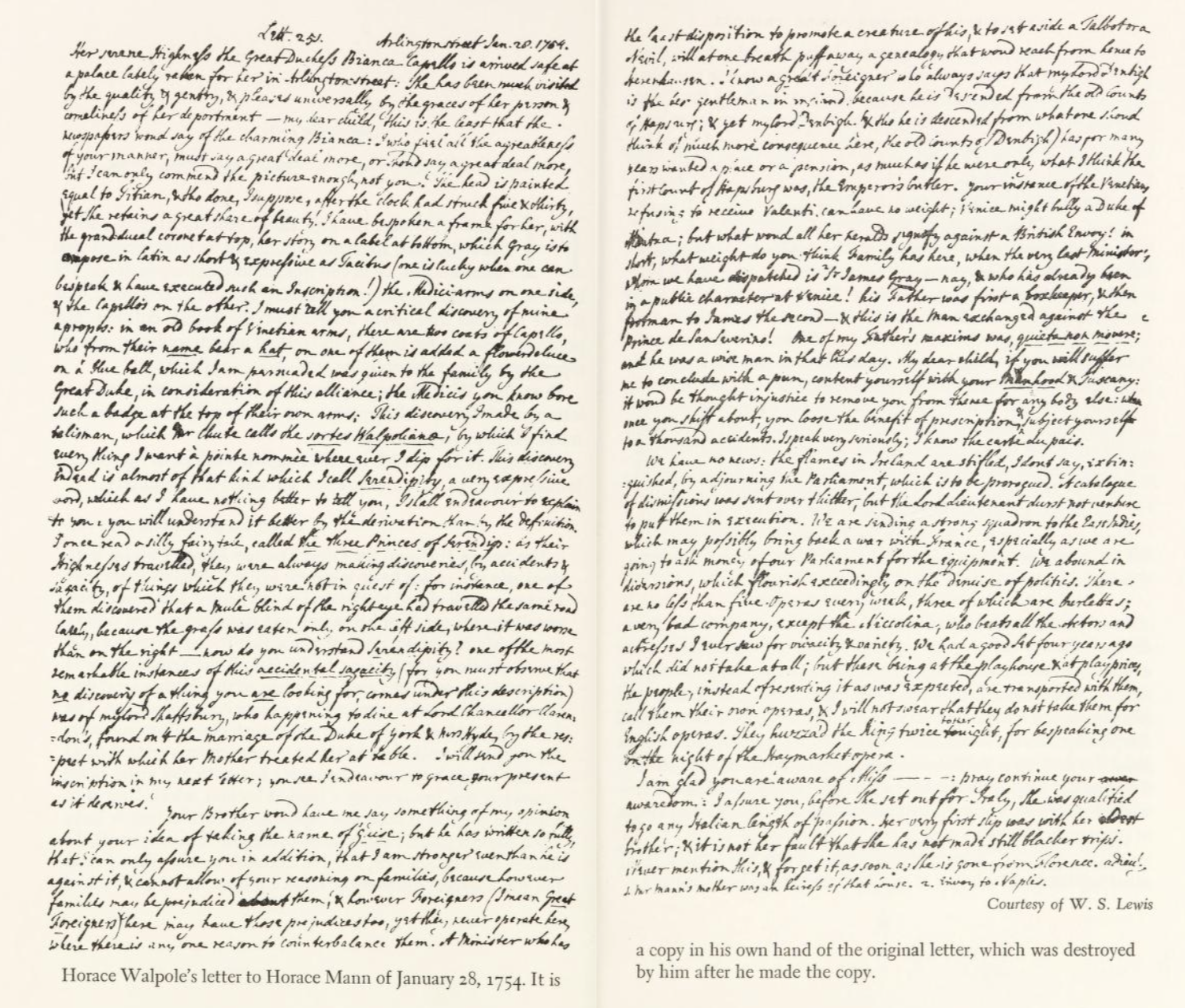
For more than 250 years, the official origin story of serendipity has rested on a single elegant sentence by Horace Walpole. In his famous 1754 letter to Horace Mann he wrote that the Three Princes of Serendip were “always making discoveries, by accidents and sagacity, of things which they were not in quest of.”
That sentence became the foundation of almost everything that followed. Dictionaries adopted versions of it. Researchers built taxonomies on it. Business writers turned it into “happy accidents.” The entire modern conversation about serendipity still orbits around Walpole’s formulation.
And the definition kept evolving. While serious serendipity research remained in its infancy well into the early 21st century — with the notable exception of Pek van Andel’s masterful 1994 article The Anatomy of Serendipity — dictionaries and encyclopedias continued to introduce new and increasingly “innovative” definitions. Almost nobody stood up to defend the real origins of the word.
The real lessons of the Peregrinaggio
The mysteries get even more intriguing if you deep-dive to the real lessons from the old Persian fairytale of the Princes of Serendip.
I have spent two years during my book project studying the origins of serendipity and the lessons learned during their peregrinaggio. The core material was Peregrinaggio di tre giovani figliuoli del re di Serendippo — the actual text Walpole claimed as his source. What I found there was not a series of lucky finds of objects the princes were not looking for. The story is a peregrinaggio: a pilgrimage — a deliberate formative journey. Their father sends the princes out so that they will learn to observe, to reason, and to judge — preparation for wise rule. What they demonstrate again and again is a disciplined form of sagacity , collective team work and strategic thinking: careful observation, abductive inference, dialogue, and the ability to read signs that others miss.
The neat formula and the original foundation of serendipity definitions: “discoveries of things they were not in quest of” is totally Walpole’s own invention. He attached a memorable phrase to a name he liked. Whether he read the full story carelessly or only partially, or at all – the result is the same: the founding definition of serendipity rests on a misrepresentation of its own source text.
And nobody has ever doubted it – except Robert K. Merton, who shelved his work about serendipity and its dissemination for 45 years! Nobody knows the reason, but I revealed it. He lost his faith to Walpole’s integrity while finding more and more circumstantial evidence against Walpole’s fabrication.
I did a rigorous Sherlock Holmesian research work, observation, anomaly detection and abductive thinking to find the elementary circumstantial evidences — some of them may have bothered also Merton! However, this is not a minor scholarly quibble. It is a foundational crack. The fact is that serendipity researchers have been fooled for more than 250 years!
The early diffusion of serendipity
It’s evident that Robert K. Merton sensed increased unease in Walpole’s letter and in his behaviour during his book project. Merton’s foundational masterpiece “The Travels and Adventures of Serendipity” (co-authored by Elinor Barber) explain that in more detail. But Merton himself never gave any reasonable explanation why he shelved his work while almost finished. Yet the at that time emergent research community largely treated Walpole’s sentence as authoritative and then allowed the meaning to drift even further. Theodore G. Remer later insisted that all of Walpole’s stated ingredients (accident + sagacity + while in pursuit of something else) must be kept together and unchanged in the definition. However dictionaries, following their descriptive mandate, were busy recording the expanding popular usages —we could even argue – innovative interpretations serving selfish research and business needs.
Popular culture and big pharma companies reduced the word to a strong positive feeling. Hollywood – style, “all good, be happy and lucky”- and single hero stories were eagerly researched! Nobody cared about survivorship bias!
Corporate language turned it into “fortunate accidents.” The first time serendipity was defined as happy accident was when Pfizer followed the suit in 1954. The company launched a now-famous advertisement in the Journal of the American Medical Association titled: Serendipity: The Happy Accident.
By the mid-1950s, the word serendipity was firmly embedded in the business sector. Companies such as GE, Standard Oil, Merck, and Pfizer all presented themselves as being attuned to “fortunate accidents,” and thus made the word part of their innovation and marketing strategies.
The original intellectual structure was steadily hollowed out. The result is the definitional chaos we still live with. A concept that began as a precise (if already distorted) idea of explaining the lessons learned from that old fairytale, became a playground of competing definitions. When a field cannot agree on the boundaries of its core phenomenon, rigorous cumulative research becomes extremely difficult. The evolvement of definition was left to dictionaries to decide following the common usage – like the Associate Editor, of OED Jeremy Marshall answered to Remer: “It is established policy of the OED that we aim to describe how words are or have been used, not how they ‘ought’ to be used.”
That’s not how you let a science domain be reframed!
My solution
Authentic Serendipity is my attempt to correct the foundation.
It does not begin with Walpole’s letter. It begins with a careful reading of the Peregrinaggio itself, and reading it alongside Arthur Koestler’s insights into bisociation, the act of creation and the logic of the jesters. What emerges is not another soft celebration of happy accidents. It is a demanding practice of observation, abductive reasoning, and prepared judgment — the very capacities the princes were sent out to develop.
I call it ‘authentic’ because it tries to recover what the original story actually contains, rather than what Walpole projected onto it. The irony is sharp: the man who coined the word appears to have understood the story less well than some of us who came centuries later. Or we just read the full text of the fairytale and understood what we read!
This is not an attack on the pleasure of unexpected discoveries. It is a refusal to keep building a research tradition on a distorted foundation. If the founding anecdote is unreliable, then much of what has been written in its name needs re-examination.
The princes were not collecting unsought objects. They didn’t find what they were not in quest of! Instead they found what they were looking for – the virtue to become wise rulers! So, we have to admit that Walpole’s letter has fooled us for 250 years.
As they father had instructed the princes — they developed during their Peregrinaggio the virtue and ability to become wise rulers! They were learning how to see and make sense of anomalies and absurdities. They used strategic thinking and abductive reasoning to create a better story, a better explanation. They were insightful jesters in the court of Emperor Beramo!
That difference changes everything. The conversation about what serendipity actually is has been running on a faulty operating system for a long time. It is time to restart it from the original source. It’s time to respect serendipity again!
The best way to adjust this is to acknowledge the ambiguity and divide the serendipity research into two domains: the already dominant Walpolean serendipity – based on incorrect interpretation of the Persian fairytale – but maybe a domain worth to keep. “The art of benefitting from unexpected” is intriguing and has been studied extensively as an independent research domain – despite the fact that it has a lot of similarities with antifragility. My suggestion is that a new scholarship is needed to start researching the authentic lessons learned from the fairytale – a domain which I have introduced => Authentic Serendipity.
More detailed argumentation, textual evidence, and the full framework appear in my forthcoming book Serendipity Unleashed – Hidden Wisdom of the Jesters (working title, out in late September).