
”For almost two centuries, Spain has hosted an enormously popular Christmas lottery. Based on the payout, it is the biggest lottery in the world and nearly all Spaniards play. In the mid-1970s, a man sought a ticket that ended in 48. He found a ticket, bought it, and won the lottery. When asked why he was so intent on finding that number, he replied, “I dreamed of the number seven for seven nights. And seven times seven is 48.”
Serendipity? Hardly – Luck? For sure!
This great example illustrates the paradox which we encounter when defining the role of luck while harnessing serendipity. The emergence of terms like ”Planning for serendipity” and ”Engineering serendipity” indicates that at least in the innovation landscape there is a well defined need to control the process of serendipity and to eliminate the effect of any luck. The objective seems to be to make serendipity somehow manageable, and by definition that might be against the core characteristics of serendipity. How much can we expect the unexpected, before it becomes expected? A dilemma waiting to be solved.
To analyze the dilemma we need to compress the various elements of serendipity into some key factors. I have understood, that in SerenA project the defined key elements are listed as: unexpected encounter – insight – and value creation. There is no specific ”luck” element involved, but since the short version of Walpole’s definition of serendipity describes it lucky accidents, we can not totally ignore the element of luck here.
How much can we expect the unexpected, before it becomes expected?
If an unexpected event or encounter will turn out to be fruitful and create some value, will depend largely on one’s ability to discover and be insightful. Therefore, ”getting lucky” is in most cases a matter of preparedness and not a result of pure luck. Being passionate and feeling the flow turn out to be much more important than trying to find ways to be lucky.
The challenge of understanding this – and the role of luck – is evident. the positive value of a happy accident will be validated in most cases many years after the initial encounter. Black Swans can lead to disaster or to prosperity on personal level, both happy and unhappy accidents can turn out to have positive or negative impacts and the borderline between serendipity and ”zemblanity” is blurred. Alexander Fleming didn’t probably feel too ”lucky” that morning he noticed that because of his sloppiness a piece of dirt –later on analyzed as mold – had contaminated his petri dishes. It was years afterwards, after his research had given positive results, when he was able to rate that accident as lucky.
If an unexpected event or encounter will turn out to be fruitful and create some value, will depend largely on one’s ability to observe, detect the anomalies and be insightful. Therefore, ”getting lucky” is in most cases a matter of preparedness and implementation power – not a result of pure luck.
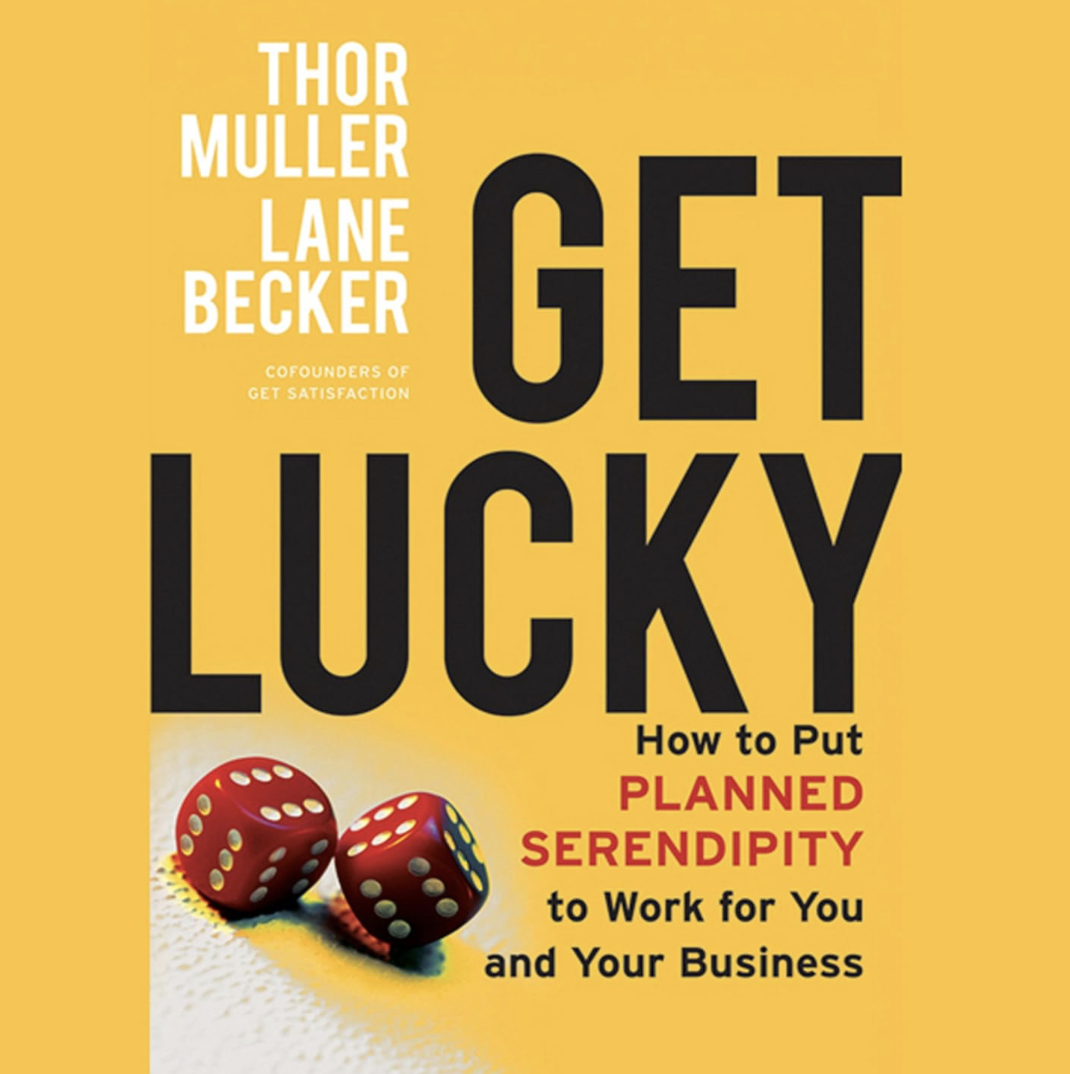
Muller and Becker surely take a different approach in their book ‘Get Lucky – How to Put PLANNED SERENDIPITY to Work for You and Your Business. The illustrative cover picture of this post maybe provocative (book cover), but it surely raises questions. What kind of game of dice you can play with these dice? What’s the point of rolling the dice? Is the beginner as good as the master?
Well, despite the misleading, “trying to be insightful” cover pic the authors do a great job. It’s an interesting book in many ways, illustrates great practical cases and gives some useful guidelines how to harness serendipity.
The authors (cofounders of Get Satisfaction) break it down into eight concrete elements you can actually practice:
- Preparedness — filling your mind with diverse knowledge so you can recognize opportunities
- Motion — getting out of your routine and exposing yourself to new people/environments
- Activation — creating constraints or triggers that break people out of autopilot
- Attraction — projecting a visible presence that draws chance encounters
- Connection — building curiosity, reputation, and accessibility
- Commitment — publicly committing to a bigger goal so others can help
- Porosity — staying open and permeable to outside ideas
- Divergence — using existing resources in radically new ways
The book is filled with real-world examples (3M Post-its, Pixar, Google, etc.) and is aimed at both individuals and organizations. It’s a straightforward, no-nonsense business manual from 2012 that treats “luck” as something you can systematically improve — not guarantee.
But the straightforward approach towards ”…just becoming lucky and serendipity will follow” – attitude might even be harmful. After reading the book one might think, that ”luck” seems to be the most essential element of serendipity and to me that’s a pretty simplified approach.
Luck is always retroperspectively validated (except in lotteries) – and much of that potential success is depending on the implementation power of the organisation or inventor!
To simplify complicated matters is challenging and needs a lot of competence and a comprehensive understanding of the phenomena. Unfortunately there is not yet enough validated research in this area, so all kind of ”shortcuts” still have a chance to succeed and get attention. My expectation – and concern – is that in near future serendipity will, partly because of these kind of highly commercialized initiatives (books, presentations, workshops etc), will become a ”buzz” word. And then it will follow the life cycle of terms like ”innovation” and ”innovative”. At the moment almost everything is innovative and the core definition of innovation is totally lost in many contexts. ”Innovation has become innoflation”, my favourite slogan, which I introduced few years ago.
The same might happen to serendipity, soon everything will be ”serendipitous” and the term will start to pop up everywhere including advertisement, fashion etc. and unfortunately appear in many occasions widely misused.
For my personal research purposes I would like to find research and publications with a bit more comprehensive approach towards the element of luck and those linking theories. My understanding is, that there are only a few blog posts describing the connections of serendipity to fundamental theories – like theory of complexity. Certainly a more ambitious approach is urgently needed. Probably that time will come soon, when the research initiatives like SerenA have produced building blocks for the solid theoretical background of serendipity. And for this ambitious and pioneering work in serendipity research field I wish to all of us– best of luck!




Great post and I definitely share your concerns about conflating luck and serendipity. I would be very interested in your perspective on the opportunity to shape serendipity that we explored in one chapter of The Power of Pull http://amzn.to/WMnV59 – excerpts from that chapter are available here http://bit.ly/VVz4k4
Thanks for your comment John! Maybe funny to thank after twelve years 😉 But I have re-activated my blog since December 2024, when I started drafting my book project. My thinking and our world has changed a lot but the mystery around serendipity is still hanging there! Please have a look to all new material and if you’ll find it still intriguing, I would be more than happy to interview you for my forthcoming book. It will be out late this year and manuscript is scheduled to be discussed in September. Have a look at my book project: https://www.respectserendipity.com/serendipity-unleashed/. Best regards, Ilkka Kakko