Cover photograph: Sacra di San Michele, referred as an inspiration for Umberto Eco. Photo: Elio Pallard, via Wikimedia Commons, CC BY-SA 4.0
The Historical Misconception: How Walpole’s Misreading Misled Us for Centuries
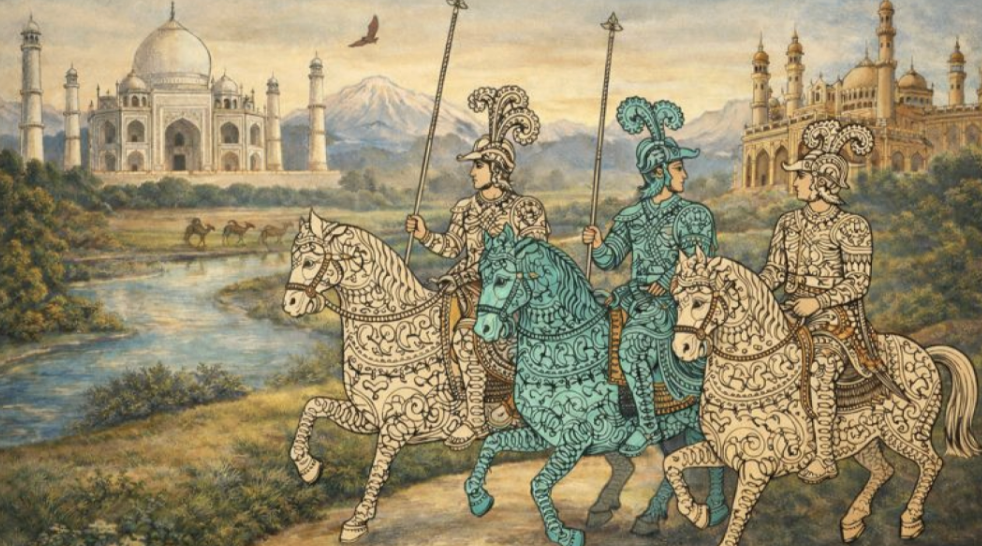
For nearly three centuries, the literature on innovation and discovery has operated under a definition of serendipity provided by Horace Walpole. In his famous 1754 letter to Horace Mann, Walpole coined the term based on a hottily remembered childhood reading of a Persian fairy tale, The Three Princes of Serendip. He defined the phenomenon as making discoveries, by accidents and sagacity, of things one was not in quest of.
However, a closer look at the actual text of the fable—as highlighted in my book Authentic Serendipity—reveals that Walpole’s interpretation was fundamentally flawed.
First, Walpole misconstrued the very nature of the princes’ journey. He framed their travels as a sort of empirical expedition looking for external discoveries. In reality, the princes were on a pilgrimage—Peregrinaggio. I argue in the book that “Peregrinaggio is not an expedition.”
The princes were not sent out to find hidden treasures or material objects. Instead, their father, the King of Serendip, had banished them with a specific educational purpose: to experience the world, to grow, and to gain virtue in order to become wise and just rulers.
Second, Walpole’s claim that the princes “were always making discoveries, by accidents and sagacity, of things they were not in quest of” misses the profound irony of the tale. The princes were indeed in quest of something: they were in quest of maturity, wisdom, and governance skills. Through every encounter and every deductive puzzle they solved along the way, they acquired exactly what they were sent out to find. Their ultimate “discovery” was their own transformation into capable rulers.
By flattening a story of internal, character-driven development into a superficial concept of “accidental discovery,” Walpole did the concept of serendipity a great disservice. He stripped the phenomenon of its purposeful, transformative element and reduced it to a passive matter of luck or casual observation. To understand Authentic serendipity, we must move past Walpole’s flawed summary and look at the cognitive infrastructure required for true, purposeful transformation.
Sean Silver’s Discovery: The Essential Gap on the “Shop Floor” of Science
While Walpole flattened the concept into a whimsical anomaly, the literary historian Sean Silver (2015) offers a crucial correction to the timeline. Silver argues that “serendipity” is not an isolated, 18th-century eccentric invention. Instead, it labels a profound and much older tension that has accompanied empirical science ever since Francis Bacon formalized the scientific method in the 17th century.
According to Silver, serendipity is intimately tied to what philosophers call the “induction problem” or the “conceptual leap”.
Baconian empiricism is built on gathering raw observations from the material world—whether in a modern laboratory or on a factory shop floor—and using induction to build general rules from those details. The fatal flaw of pure induction, however, is that it relies entirely on the past remaining consistent. It cannot predict or explain the moment when the material world “nudges back” with something entirely unexpected.
This creates what Silver calls an essential gap in epistemology—a cognitive blind spot on the very floor where research and production take place. Studies of innovation often treat serendipity as a “here-and-now” mechanical tool, focused merely on how we model data in practice. They analyze the structure of the unexpected insight through neurobiology or data analytics, but they fail to address the historical and philosophical nature of the gap itself.
The anomaly Silver uncovers is this: modern organizations excel at collecting real-time data from labs and production lines, yet they remain systematically blind to breakthroughs. They operate under the assumption that more data and better induction will automatically yield new insights. But as Silver’s historical recovery implies, a conceptual leap cannot be automated by the mere accumulation of facts. Pure induction only traps us within our existing definitions. When an anomaly overthrows those definitions, the straight path of data collection fails, leaving a critical gap that traditional science and metrics cannot bridge.
Why Induction Fails When the Material World Nudges Back
The core failure of traditional data analysis—whether in 17th-century empiricism or 21st-century corporate strategy—lies in its reliance on induction.
Induction operates on the assumption that the future will behave like the past.
It aggregates real-time data from the laboratory or the factory floor to optimize existing processes. But as I emphasize in Authentic Serendipity, traditional logical paths like induction and deduction are fundamentally incapable of generating entirely new theories.
The breakdown occurs the moment the material world “nudges back” with an anomaly—an unexpected deviation from the expected norm. When a purely inductive system encounters an anomaly, it faces a structural crisis. Because the system is programmed to recognize patterns based on past data, it cannot comprehend a completely novel phenomenon.
I have pointed out a systemic flaw in how modern organizations and rigid AI frameworks handle these moments: they suffer from a lack of cognitive infrastructure, which leads them to actively “kill anomalies.” When a deviation appears on a research report, the immediate reflex is to treat it as a system error, a glitch, or noise to be cleaned out. In trying to eliminate variance to maintain compliance with established definitions, organizations inadvertently destroy the very raw material required for a breakthrough.
This tension between rigid dogma and the reality of unexpected data is beautifully illustrated in Umberto Eco’s classic novel, The Name of the Rose. The protagonist, William of Baskerville, represents the antithesis of a blind inductive machine. Confronted with a series of bizarre and anomalous murders within a medieval monastery, William does not rely on a fixed, pre-existing checklist of sins or mechanical procedures. Instead, he continuously generates new, flexible hypotheses. He treats each unexpected clue not as an error to be dismissed, but as a living anomaly that demands a reorientation of his understanding.
When we try to optimize everything through pure induction, we mistake the map for the territory. Like the dogmatic monks in Eco’s monastery, we try to force reality into our pre-existing books and KPIs. But when the straight path of definitions is overthrown by an anomaly, relying on more data collection is useless. True discovery requires the willingness to abandon the old script and, like William of Baskerville, remain open to the fluid generation of new hypotheses when the world surprises us.
The Abductive Leap: Enter the “What If” Catalyst
To understand how William of Baskerville operates, or how a scientist navigates the epistemological gap described by Sean Silver, I have introduced a third mode of inference: abductive reasoning. Formulated by the philosopher Charles Sanders Peirce (and famously applied to Eco’s William by literary theorists), abduction is fundamentally different from deduction and induction. While deduction proves that something must be, and induction shows that something is actually operative, abduction is the only logical form that suggests something may be.
It is the only inference capable of introducing a completely new idea.
Abduction is the cognitive mechanism behind Silver’s “conceptual leap.” When an inductive system encounters an anomaly and breaks down, the abductive mind does not retreat. Instead, it performs a creative, yet highly educated guess to form a completely new hypothesis that can account for the strange phenomenon.
In the process of authentic serendipity, this leap is catalyzed by what I call the flash of “What If” thinking. When the material world delivers an unexpected nudge, the traditional observer asks, “What went wrong?” and seeks to fix the error.
The abductive observer, however, shifts the paradigm by asking, “What if this deviation is actually a pointer to a new reality?” This single shift in inquiry transforms raw, confusing anomalies into what Robert K. Merton termed strategic data—information that has the power to reorient an entire field of knowledge.
This is why serendipity has historically been so difficult to analyze or model mechanically. Abduction requires an intuitive leap that feels, on the surface, unscientific to a rigid empiricist. It requires the courage to temporarily overthrow established definitions and entertain a possibility before any deductive proof exists. It is not a matter of casual, passive luck or finding something we were not in quest of ala Walpole. Authentic serendipity is a disciplined, cognitive capability—an active deployment of abductive reasoning that allows us to crete a new story/theory precisely as it flies.
Conclusion: Cultivating the Cognitive Infrastructure for 21st-Century Jesters
If we are to navigate the complexities of modern innovation, we must finally abandon Horace Walpole’s legacy. Viewing serendipity as the mere whim of a cultural trifler—has led 21st-century organizations into a dangerous trap. It has allowed us to believe that we can automate discovery simply by building larger databases, increasing real-time monitoring, and relying on pure induction to optimize our processes. But as Sean Silver’s historical analysis reminds us, the essential gap in our epistemology cannot be closed by data accumulation alone.
Discovery has always required a conceptual leap.
To make that leap possible on the shop floors and in the laboratories of today, organizations must shift their focus from mechanical optimization to building a deliberate cognitive infrastructure.
This means shifting from a culture that fears and deletes variances to one that actively respects serendipity. We need to create spaces where anomalies are not treated as system errors to be neutralized, but as strategic invitations to deploy abductive reasoning.
Practically, this requires what I describe as the cultivation of 21st-Century Jesters—individuals or archetypes within an organization who possess the intellectual agility of William of Baskerville. These modern “court jesters” are destabilizing agents whose primary function is to challenge established dogma, look past salient matters and mode focus to relevant ones, and ask the disruptive “What If” questions that traditional systems filter out.
Authentic serendipity is not a random accident that happens to a passive observer. It is a rigorous, active mindset —a cognitive pilgrimage of a prepared mind that intentionally remains open to transformation. By establishing the Smile in Mind infrastructure necessary to sustain abductive leaps, we stop waiting for luck to strike. Instead, we train ourselves to recognize the unexpected nudges of the world and turn them into the groundbreaking discoveries of tomorrow.