
Who is your favorite philosopher?
Mine is Yogi Berra. Fat Tony comes a close second.
Both have a gift for spotting absurdity beneath respectable language—and there is plenty of respectable language circulating in business.
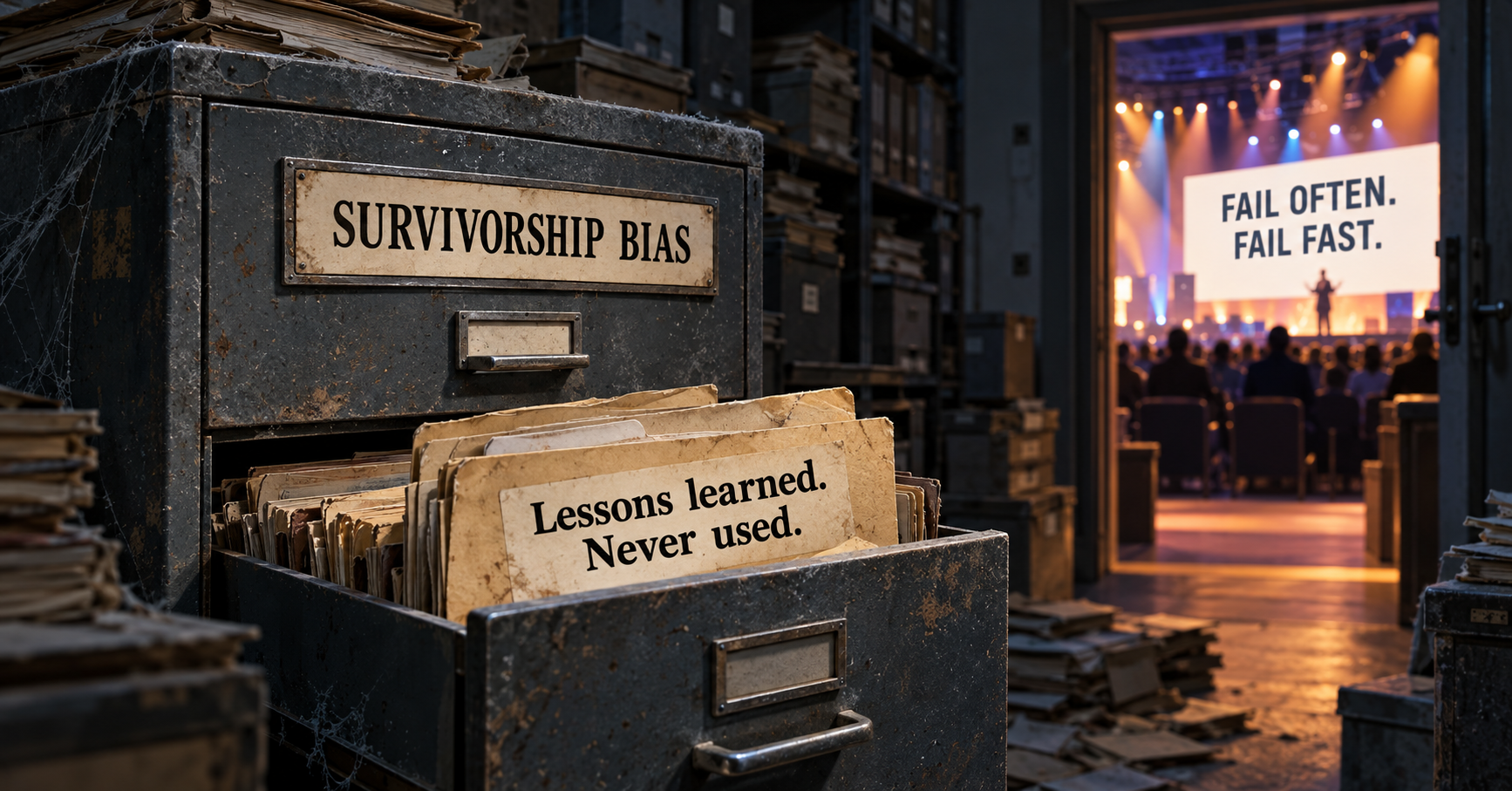
Take this familiar piece of wisdom: “Fail often. Fail fast.”
It sounds wonderfully liberating when failure is a slide in someone else’s presentation. My experience—and that of countless others—is filed away under “Forgotten through survivorship bias.”
I have made two catastrophic mistakes. Together, they cost me my home and belongings, left me facing debt enforcement, and overshadowed ten years of my life. I understood what had gone wrong. I learned my lessons. What I question is the comforting assumption that those lessons would eventually make the failures worthwhile.
More than thirty years later, I am still waiting for the opportunity to use them.
A beautiful island and two dangerous assumptions
In 1988, a company I co-owned bought a beautiful eighteen-hectare island on Lake Päijänne (the second largest lake in Finland), approximately three kilometers north of Pulkkilanharju. It had about two kilometers of shoreline.
Anyone familiar with the Finnish lake district will understand its appeal.
We financed the purchase with a foreign-currency loan. Finnish banks were aggressively marketing these loans, and the lower interest rates made them attractive. We accepted the offer.
The investment rested on two assumptions. The first concerned the financing: we took on debt in a currency different from the one in which we would have to find the money to repay it. The second concerned the land: we anticipated being able to obtain planning permission for shoreline building plots.
Then the circumstances changed. The Finnish markka was devalued in November 1991 and allowed to float in September 1992. Its subsequent depreciation dramatically increased the markka cost of our foreign-currency debt. The loan had become heavier without our borrowing another markka.
At the same time, the island’s development prospects became uncertain. Rumors circulated that the nearby nature reserve would be extended, preventing the development we had anticipated. When we wanted to sell, that uncertainty severely undermined the island’s value.
The debt grew while the asset’s value collapsed.
Our company went bankrupt, but the loan obligations remained with us personally.
A second investment, in professional ice hockey-franchise, compounded the losses. I lost my investment in share capital and was left with obligations arising from personal loan guarantees. That is another story; its relevance here is that the consequences of both investments followed me long after the companies themselves could no longer carry them.
These experiences unfolded during Finland’s devastating early-1990s recession. Many entrepreneurs and families found themselves trapped by debt, falling asset values, and personal guarantees.
We became part of the group known in Finland as lamavelalliset: the debtors of the recession.
There was nothing to glorify in living with the aftermath—and nobody invited me into the spotlight to explain how wonderfully I had failed.
My mother had already explained the learning part
My mother had told me: “You learn from your mistakes.”
She was right. I understood my lessons straightaway: never again take a foreign-currency loan; never assume that land beside a protected area can be approved for development; never build an investment around promises from politicians and city officials.
I remembered those lessons. I still do.
But here is the missing piece in the familiar advice: I have never since encountered a comparable situation in which to apply them. I have not bought another island with a foreign-currency loan. I have not financed another professional hockey team whose economics depended on a promised municipal arena expansion.
Thirty years. Expensive lessons. No comparable opportunity to use them.
Someone might reasonably say that remembering these experiences made me more cautious. Perhaps it did. They became part of my judgment, and I cannot know every decision they quietly influenced. But that possibility does not establish that the losses were necessary, proportionate, or ultimately beneficial.
Learning something and recovering value from that learning are separate events. We tend to speak as though the second follows naturally from the first. It may never happen.
The context does not come back with the lesson
A failure happens somewhere, at a particular time, among particular people. Its consequences depend on financing arrangements, institutional decisions, market conditions, personal obligations, and events beyond anyone’s control.
Afterward, we compress that complicated experience into a portable sentence: “Never do this again.”
The sentence travels easily. The circumstances that would make it useful may never return.
Some lessons can be applied repeatedly. A small experiment can reveal a mistaken assumption, and the next attempt can test a better one. There is real value in that kind of learning. But buying an island, guaranteeing substantial loans, or committing much of your accumulated capital is a different experience. You may have one attempt, followed by years of consequences.
Before celebrating failure, I would like to know whether another attempt remains possible—and whether the lesson can help when it arrives.
“Fail fast” describes the speed at which an experiment might end. It tells us remarkably little about how long the obligations will last.
Who gets invited to tell the failure story?
The people on stage tend to be those whose failures eventually became stepping stones to success. They can look back, connect the dots, and tell a coherent, – yet retrospective – story about perseverance.
Their experiences deserve to be heard. So do the experiences that never acquired a triumphant ending.
This is where survivorship bias enters the room.
When we hear mainly from people who recovered, we can begin to treat recovery as the expected outcome. The losses become an investment in future wisdom. Failure becomes a necessary chapter on the way to success.
Meanwhile, other stories remain in the filing cabinet: lessons learned, never used.
My eventual ability to rebuild my life does not mean those particular lessons repaid their cost. I can be grateful for my life today and still question the claim that every catastrophe contains a blessing waiting to be discovered.
I would rather hear advice that takes the consequences seriously before asking people to embrace the experience.
Making the right mistakes
Perhaps this is a task for the 21st-Century Jester: interrupting an attractive slogan with the question its audience most needs to hear.
“What makes you so sure this failure will become useful?”
That question creates space for judgment. How much is at stake? Who carries the loss? What might we learn? Where could we apply it? Will we still have the resources and freedom to try again?
After the Yankees lost the 1960 World Series, Yogi Berra put it beautifully:“We made too many wrong mistakes.”
I made only two—but they were the wrong ones. Enough to ruin my life for ten years. His observation inspired a phrase of my own:
“I love to make the right mistakes.”
For me, a mistake earns that description when I can put what it taught me into practice. I welcome experiments that challenge my assumptions and reveal something meaningful, while leaving room to act on the discovery.
Until that happens, I have paid for a lesson whose usefulness remains unproven.
Looking back, which of your mistakes were the wrong ones—and have you learned to make the right ones?


