

As this, or any other, complex word grows in usage, it gathers up many new meanings… to the point where its original precision of denotation is lost.” — Robert K. Merton, The Travels and Adventures of Serendipity (1958)
Robert K. Merton wrote those words seventy years ago, but they sound like they were meant for this moment. He warned that serendipity, like any complex idea, might one day be overused, distorted, and finally “debased.” That prophecy has now been fulfilled. Today, “serendipity” is everywhere — in marketing slogans, TED talks, and AI apps that promise to “engineer serendipity.” What began as an item of precious esoterica has become a hollow buzzword. The very fate Merton described as “waiting offstage” has now taken center stage.
The Anomalies That Started It All
When I began my long book project, I deep-dived to the origins of serendipity; the original fairytale, Walpole and Merton’s observations. I had an open mind, but step by step I became cautious. Too many anomalies, too many inconsistencies in a hollow story. I stated to wonder if we have been fooled almost 300 years about the lessons learned from the old Persian fairytale. What we were told about the origins of serendipity and what the evidence actually showed – there was too many details , which didn’t match!
The original Persian fairytale The Travels and Adventures of the Three Princes of Serendip wasn’t about “happy accidents.” – it was a Peregrinaggio – a pilgrimage. It was about wit, teamwork, and the art of observation — it highlighted the very qualities of the princes, their actions as jesters in Emperor Beramo’s royal court. Horace Walpole, when he coined the word in 1754, reshaped that story to fit his own peculiar oddities, describing the princes as lucky wanderers instead of what they truly were, the faithful sons of a father who sent them to pilgrimage. Their only goal and their father’s wish was to become wise rulers when needed in future. And then came Merton, who in the 1950s already saw what was happening: the gradual dilution of a once-precise concept into fashionable vagueness.
Three anomalies — in the fairytale, Walpole’s letter, and Merton’s warning — formed a perfect abductive triangle. From their intersection emerged what I now call Authentic Serendipity.
Merton’s description of linguistic decay is more than semantics — it’s sociology in action. He explained how words migrate through intellectual circles: first esoteric, then popular, then clichéd. The tragedy of serendipity is that its diffusion became its destruction. As Merton put it: “Those who first welcomed it for its freshness come to reject it as a cliché.”
This is the paradox of modern innovation culture. In trying to manufacture serendipity, we lost the very state of mind that enables it. We turned a delicate human phenomenon — rooted in awareness, sagacity, empathy and humor — into a management technique.
Authentic Serendipity is not about luck, algorithms, or density of encounters. It is a state of mind — playful, prepared, and perceptive. It belongs to those who can hold paradoxes, laugh at authority, and see what others miss — in short, to the jesters. The princes of Serendip were not “young scientists stumbling upon happy accidents.” They were court jesters, whose role was to uncover truth through stories, riddles, and wit. They embodied the spirit of bisociation long before Koestler gave it a name.
To move forward, we must let go of what I call Walpolian Serendipity — the comfortable illusion that discoveries are accidental and individual. That narrative flatters luck and ego, but it misrepresents reality. True breakthroughs are collective, contextual, abductive and strategic. Authentic Serendipity thrives in environments where jesters, sages, and artists intersect — where anomalies are not feared but welcomed. It is not about “getting lucky.” It is about being ready when anomalies whisper their hidden messages.
Respect Serendipity
Merton foresaw the danger. Koestler gave us the tools. And the Three Princes left us the clues. Our task today is to restore and reframe what has been lost — not by nostalgia, but by understanding. Authentic Serendipity is not something we can design; it’s something we can deserve through sagacity, curiosity, and the courage to laugh at our own certainties.
So yes — I abducted authentic serendipity, the real lessons learnt from the famous Peregrinaggio di tre giovani figliuoli del re di Serendippo !
From anomalies. From misreadings. From translation errors.
And if you’ve read this far, maybe you can help me finish the act. Together, let’s bring Authentic Serendipity back onstage — before the curtain falls again.
Respect Serendipity. Trust your inner Jester.
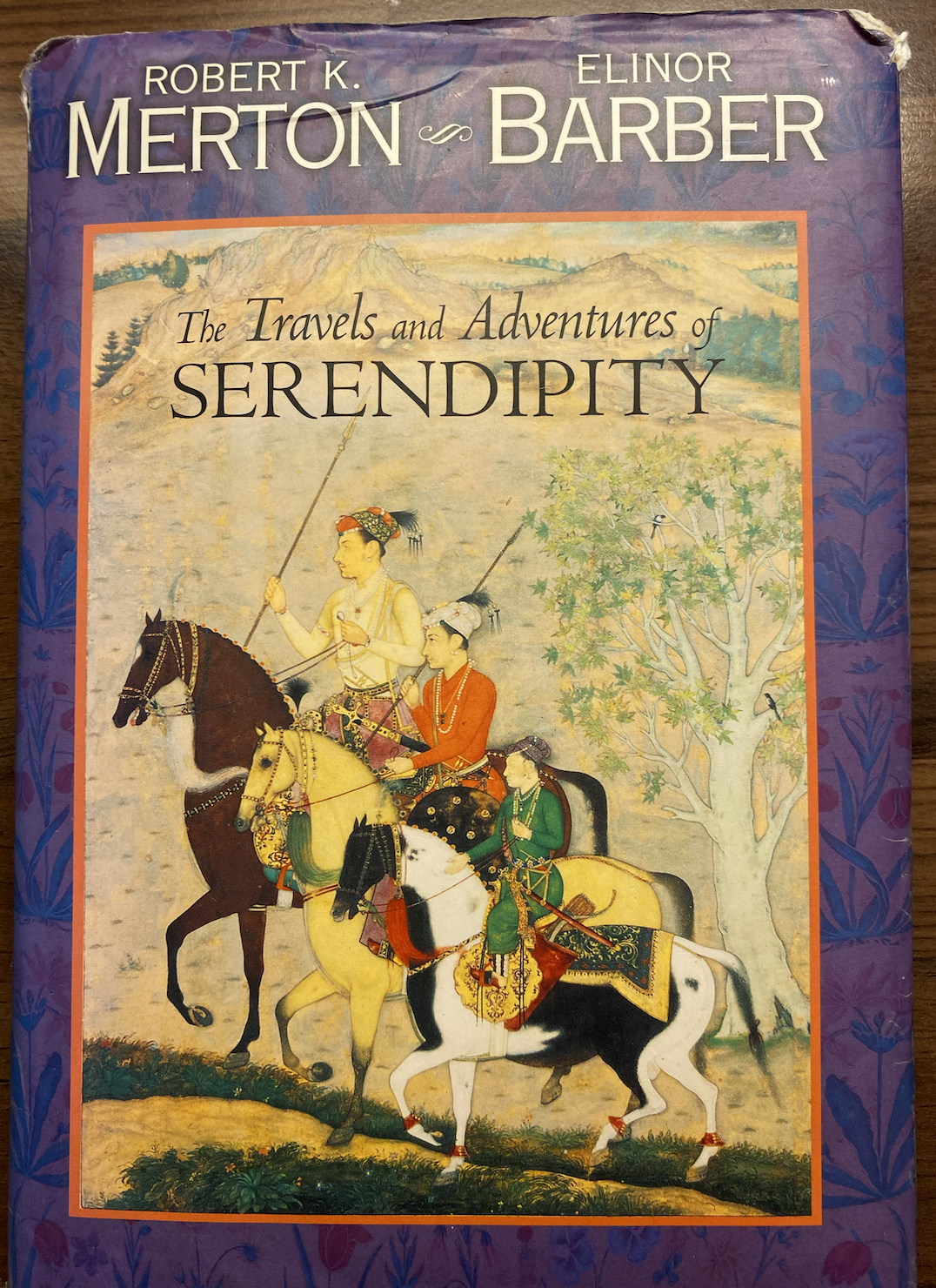
Photo courtesy: Robert K. Merton & Elinor Barber The Travel and Adventures of Serendipity, Princeton University Press, 2004, p. 65



For the last 26 years I am one of your Serendipitor brothers. I have also written an unpublished book,
in ink, calligraphy and painting on handmade paper titled “The neverending path of serendipity”
Today through a series of unplanned events, I landed on your website and I smiled.
Contact me so I can send you a scan of the first pages 🙂
Thank you for being out there!
Billy