Jerome Bruner (1915–2016) was one of the most influential psychologists of the 20th century — a pioneering thinker who reshaped our understanding of learning, perception, culture, and the very nature of thinking itself. A founder of the “cognitive revolution” in psychology, Bruner’s work spanned six decades and touched fields as diverse as education, narrative theory, creativity research, and the study of meaning-making. While he is widely recognized for his contributions to learning theory and developmental psychology, his more philosophical reflections — especially those in On Knowing — remain surprisingly overlooked. Yet these essays contain some of the deepest insights ever written about how discovery happens, why insights emerge, and what it means to truly “know” something.
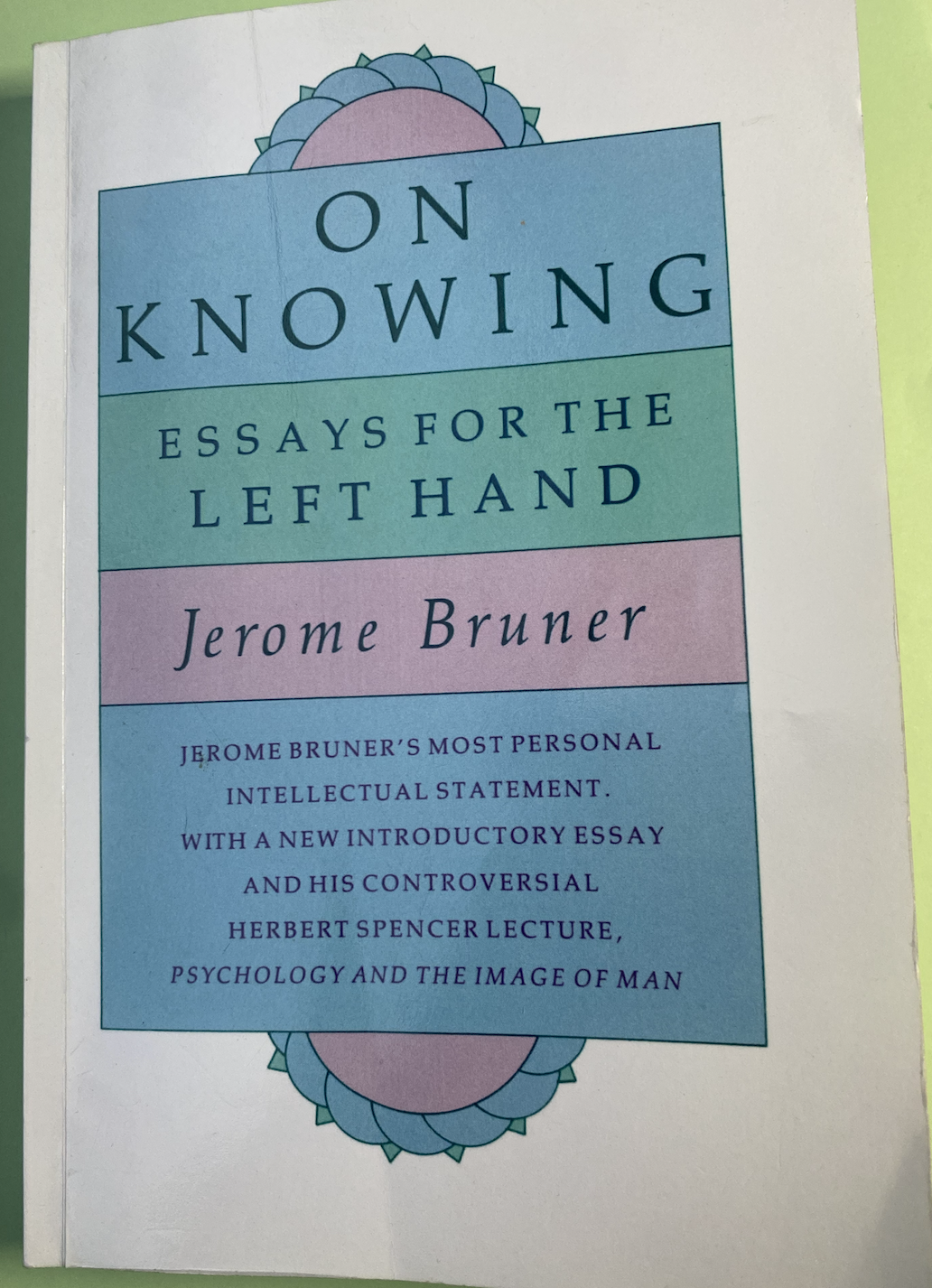
I love his masterpiece On Knowing – Essays for the Left Hand, which was originally written as separate essays about matters that were “interesting”, as he says. He explains that each essay began as a conversation, and he describes wonderfully how these conversations eventually became boring. And here he comes to an insightful argument, which I can 100 % back up:
Boredom is a powerful phenomenon – a poison to the intellectual in large doses, but like many poisons, it’s rather benign stimulant in small doses.
He continues saying “I think it (boredom) always infuses intellectual work in some deep way. For all sciences and most of the humane disciplines of learning proceed by working with familiar and attempting to rearrange it in certain ways as to make the familiar generate something novel.” His brave statement in Preface -section gives hope for a provocative writer like myself when talking about his effort to bring in his essay “Psychology and the Image of Man” the two views of psychology back into single focus. “It did not convince any of my Oxford friends who were initially of a contrary view, but unpopular views may at least seem to raise consciousness about alternatives. In any case, it created a good row – and this is always welcome on the British intellectual scene.”
I find of this collection of essays the most intriguing “The Conditions of Creativity”, which is “his first attempt, a preface to a more systematic analysis, of creative invention”. It’s highly interesting that Bruner positions here himself “in the role of a would-be mediator between the humanist and the scientist”. For me as a ‘hobbyist serendipity researcher’ the most valuable findings are his coinages of “effective surprise” , “shock of recognition” and a brutal yet so fitting statement:
The road to banality is paved with creative intentions.
Here is a direct quote (Bruner: On Knowing: Essays for the Left Hand p. 18, bolding is mine): “We had best begin with some minimum working definition that will permit us at least to look at the same set of things. An act that produces effective surprise — this I shall take as the hallmark of a creative enterprise. The content of the surprise can be as various as the enterprises in which men are engaged. It may express itself in one’s dealing with children, in making love, in carrying on a business, in formulating physical theory, in painting a picture. I could not care less about the person’s intention, whether or not he intended to create”.
Bruner’s core idea is deceptively simple: “An act that produces effective surprise — this I shall take as the hallmark of a creative enterprise.“ Discovery, he argues, is not achieved through methodical plodding but through restructuring — seeing what we already know in a new frame. That comes so close to Koestler’s term bisociation, the collision of two contradictory matrixes of thought. Similarly Bruner’s statement that Effective surprises seem rather to have the quality of obviousness about them when they occur, producing a shock of recognition following which there is no longer astonishment is exactly what Koestler writes in his masterpiece “The Act of Creation”:
“The more original a discovery, the more obvious it seems afterwards.”
And how similar this is to Gary Klein’s argument that insight is an unexpected shift to a better story. And when we have an insight it’s unique, when they appear they are coherent and unambiguous. Like Klein says, they don’t come as part of a set of possible answers, when we have the insight we think: “Oh yes, that’s it!”. Referring to Klein: “We feel a sense of closure, and this sense produces a feeling of confidence in this insight! We are not picking an idea that seems better than others. Instead, we are struck that this is the answer!”
Bruner speaks of the shock of recognition — that uncanny moment when something unfamiliar suddenly feels deeply right. Again this is exactly what Klein says above, this resonates with his insight as a shift to a better story and his brilliant coinage creative desperation, which is one cornerstone in my authentic serendipity framework. If you’re familiar with the work of Koestler, you’ll recognise this as bisociation in action. If you favor Robert K. Merton’s take on serendipity, Bruner already offers the cognitive blueprint for Walpole’s questionable coinage of accidental sagacity. And as Pek van Andel later emphasized, serendipity has nothing to do with luck and hunting endlessly ‘serendipitous encounters’ — it’s about recognising the significance of the unexpected, spotting anomalies and trusting in abductive reasoning by forming the most likely explanation based on limited information.
Bruner, without using the term, is actually describing the psychological conditions of authentic serendipity.
Bruner was never just a psychologist. He was a cognitive cartographer of the left-hand path — mapping the mythic, metaphorical, antic spaces where discovery lives. That his ideas are resurfacing today, often uncredited or renamed, is not a tragedy. It’s a victory.