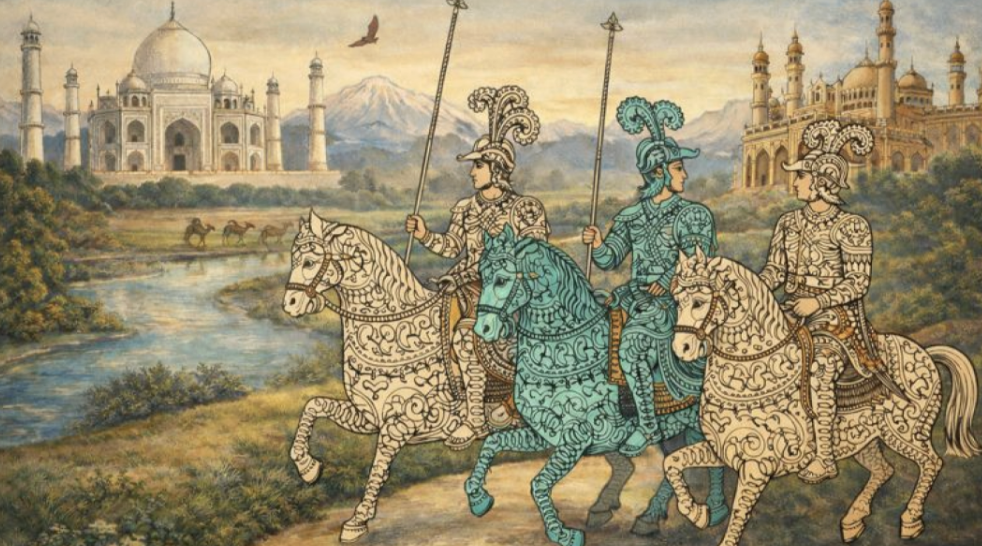
In my previous essays, I explored how certain crucial concepts — unanticipated, anomalous, strategic — have quietly slipped out of our collective vocabulary of serendipity definitions. My ‘Recommended reading’ blog about Merton ‘s book The Travels and Adventures of Serendipity explained the mysteries surrounding the very origins of serendipity and how those earlier happenings caused a lot of ambiguity in serendipity definitions.
This essay takes the next step. We move from vocabulary and sloppy serendipity definitions to the true lessons learned from Peregrinaggio di tre giovani figliuoli del re di Serendippo.
The Problem: Serendipity Without a Spine
Serendipity is everywhere today. It appears in innovation slides, leadership talks, and platform slogans. Yet the more frequently the word is used, the less ambiguous it seems to become.
Surprise alone is now often treated as serendipity. Coincidence is mixed up with serendipity, as well as chance insight — even when it never leads anywhere.
But serendipity, in its original and meaningful sense, was never just about noticing something interesting.
Without strategic thinking, implementation and value creation, serendipity remains incomplete. What we are missing is not enthusiasm — but the understanding of the true lessons of the Persian fairytale.
Authentic Serendipity: A Necessary Distinction
This is where a distinction becomes unavoidable.
During my repeated and careful rereading of The Travels and Adventures of Serendipity a series of interpretive anomalies began to emerge — not in the original Persian fairytale, but in how its “lessons” have been summarized and transmitted since the eighteenth century.
Most strikingly, Horace Walpole’s interpretation of the Peregrinaggio di tre giovani figliuoli del re di Serendippo does not withstand close scrutiny. His claimed “lessons learned” — centered on a narrowly deductive reading of the mule/camel episode — fail to account for the broader abductive and strategic reasoning that characterizes the princes’ actions throughout the narrative. Not even close.
The original narrative tells a far more demanding story: what the princes observed, which anomalies they detected, how they reasoned abductively, how they reframed situations strategically, and how they acted to create outcomes of value. These are not incidental details — they form a coherent logic.
Documenting these actual lessons became necessary. It is in this context that I introduce the notion of Authentic Serendipity: a framework derived from the internal logic of the Peregrinaggio itself, rather than from its later misinterpretations.
As the cover image illustrates, Authentic Serendipity is not a moment of surprise. It is a process — through disciplined thinking and action — by which something genuinely new and valuable comes into being.
This distinction is not semantic. It is foundational.
The Missing Cognitive Move: Abduction
At the heart of Authentic Serendipity lies a form of reasoning that is still poorly understood outside philosophy: abduction.
The American philosopher Charles Sanders Peirce distinguished three modes of reasoning:
- Deduction, which explains what must be true given existing rules.
- Induction, which generalizes patterns from repeated observations.
- Abduction, which asks a different question altogether: What could be true here?
Abduction is the only form of reasoning that allows us to generate new explanatory stories. It does not optimize what already exists; it reframes the situation itself.
Without abduction, serendipity collapses into coincidence.
Why Abduction Is the Engine of Authentic Serendipity
When an anomaly appears, deduction cannot help — the rules no longer fit. Induction cannot help either — there is no established pattern to generalize.
Only abduction allows a prepared mind to propose a plausible but unproven hypothesis that suddenly makes the situation coherent again.
This is not guessing. Abduction is a disciplined leap — imaginative, yet constrained by reality.
It is the moment when one dares to say: If this were true, everything else would suddenly make sense.
That leap is the turning point of Authentic Serendipity.
The Authentic Serendipity Chain
Abduction, however, is not the endpoint — it is the hinge.
Authentic Serendipity unfolds through a demanding sequence that transforms an unexpected observation into real-world value. When any link in this chain is missing, the outcome may still be interesting — but it is no longer serendipity.
I describe this logic as the following progression (illustrated in cover picture) :
Observation → Detection of an anomaly → Abductive reasoning / Strategic reframing → Creation of a better story → Implementation → Value creation
This entire chain matters. Insight without implementation remains insight — not serendipity.
Provenance: Where This Logic Comes From
It is important to clarify that this logic does not originate in modern innovation theory, nor in Horace Walpole’s later interpretation of the Persian fairytale. Walpole coined the word (actually from the title of the fairytale), but the deeper method of serendipity is already present in the original Peregrinaggio di tre giovani figliuoli del re di Serendippo.
The most revealing episode is the Diliramma case, where this entire sequence appears in action with striking clarity. Yet this episode is not merely overlooked — it is systematically absent from most modern accounts of serendipity. Just a proof that discussion and research has focused on Walpole’s false interpretations of the fairytale — that’s why I have started to call it Walpolean Serendipity.
Much of today’s discussion relies on recycled interpretations rather than direct engagement with the original sources.
Even Remer’s careful historical reconstruction is rarely consulted, which helps explain why serendipity is so often reduced to surprise or luck.
I will open and analyze the Diliramma episode in detail in my forthcoming book Serendipity Unleashed.
A Contemporary Illustration — and Why It Matters
This logic is not historical nostalgia. It is alive.
The development of reusable rockets at SpaceX offers a clear contemporary illustration of authentic serendipity in action. For decades, the dominant assumption in aerospace engineering was that rockets are disposable. This assumption was rarely questioned — it was simply how things were done.
The anomaly was economic rather than technical: the prevailing cost structure made truly ambitious goals increasingly implausible.
The abductive leap was strategic: What if rockets could return, land, and fly again?
This reframing — strongly associated with Elon Musk — was not an act of optimization within an existing model. It was the creation of a better story: a new explanatory and strategic framework that reorganized engineering constraints, business logic, and long-term possibilities.
That story was then relentlessly implemented — and only through implementation did it become real. This is authentic serendipity in action.
SpaceX is not an outlier. In my book Serendipity Unleashed, I examine multiple historical and scientific cases where authentic serendipity follows the same internal logic: disciplined observation, abductive reframing, the creation of a better story, and disciplined implementation. These include cases as diverse as Kepler’s Eight-Minute Epiphany, Gutenberg’s printing breakthrough, Darwin’s long struggle with unresolved anomalies, Eiji Nakatsu’s biologically inspired redesign of the Shinkansen, Frank Fish’s work on whale-inspired hydrodynamics — and even Musk’s Gigapress.
Across centuries and disciplines, the pattern remains remarkably consistent.
9. What’s Next
At this point, it is reasonable to draw a line.
Walpolean Serendipity— the study of unexpected findings, surprise, and accidental discovery as such — has its place. My own definition of Walpolean Serendipity is “the art of benefitting from the unexpected “. Scholars may continue refining it, debating its nuances, and exploring its historical and philosophical implications.
There is nothing wrong with being surprised, lucky, or pleased by the unexpected. Let that conversation continue.
But that is no longer my focus. And I hope that some scholars also turn their focus on researching Authentic Serendipity. It offers intriguing topics for the further research and the development of methodologies to harness it.
What interests me now — and what this forum will concentrate on — is Authentic Serendipity: a demanding, disciplined process through which observation, abductive reframing, collective sensemaking and purposeful action lead to the creation of something genuinely new and valuable.
This distinction becomes especially consequential in business, innovation, and organizational contexts — precisely when something does not yet exist and cannot be reached through optimization, best practices, or linear planning.
In my upcoming essays I will clarify why Authentic Serendipity is so much more powerful than Walpolean Serendipity. In most business cases — when trying to create entirely new things and services — the goal is innovation, rather than explanation. I will also highlight the collective sensemaking and the ability to frequently create new things — a viewpoint that Walpolean serendipity scholars and practitioners have totally neglected, even though these attributes are the key for success in business context!
Stay in the channel for new updates!