
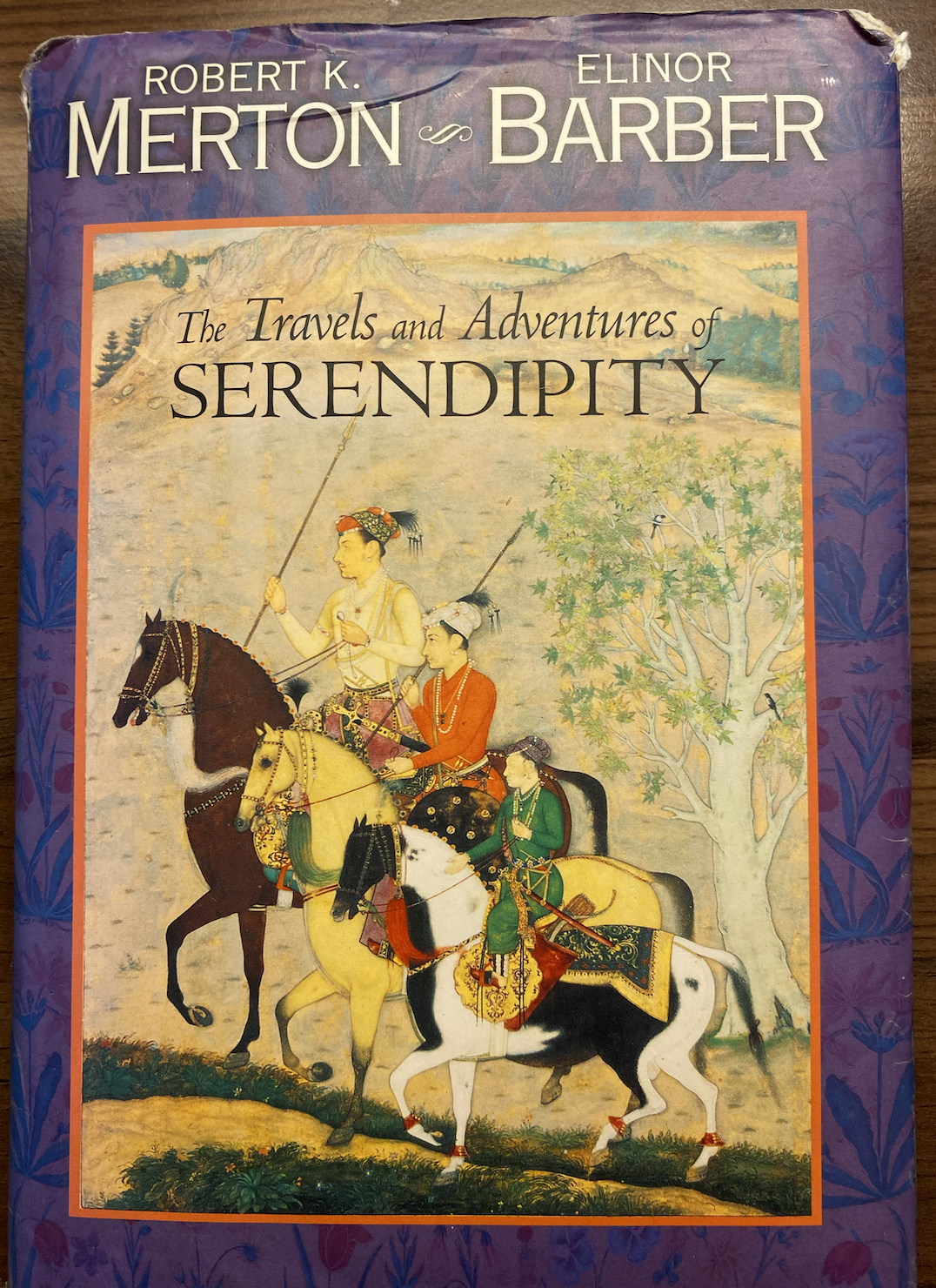
Some books inform you. A few books accompany you.
And a very small number become intellectual landmarks you return to again and again, each time discovering something new.
For me, Robert K. Merton & Elinor Barber’s The Travels and Adventures of Serendipity belongs firmly in that last category.
This is not a casual read.
It is a deeply researched, historically rich exploration of how the word “serendipity” was coined, how it travelled, transformed, and occasionally drifted as it moved through cultures and centuries. Merton’s intellectual craftsmanship is on full display — precise, curious, witty, and always grounded in evidence.
For anyone interested in the true origins and evolution of serendipity, this book is indispensable.
1. Merton’s Mastery of Intellectual History
One of the great pleasures of reading this book is witnessing Merton as a historian of ideas.
He traces the early diffusion of “serendipity” with such elegance and rigor that whole chapters read like miniature tours of intellectual archaeology.
He uncovers:
-
the earliest appearances of the word
-
forgotten usages in scientific correspondence
-
misquotations and reinterpretations
-
cultural shifts that slowly broadened the meaning
-
how certain anecdotes — sometimes almost by accident — became central to the concept
Merton is often remembered as a sociologist of science, but here he demonstrates an equally rare talent: a meticulous observer of the life of ideas.
For this alone, the book is worth owning.
2. A Book With a Strange Life Story
But the book itself also has a story — a rather unexpected one.
Merton began working on this manuscript in the early 1950s. He conducted rigorous research on the origins of Walpole’s mysterious coinage and its early diffusion. He drafted large portions of the manuscript. He refined its arguments.
And then… he set it aside. Decades passed – and manuscript of this masterpiece was stored in his office.
When dismissing his work with serendipity he became quickly absorbed by a new project — On the Shoulders of Giants — a humorous and profound meditation on the transmission of knowledge, misattribution, and intellectual lineage. A book which is the highlight of his career and improved his reputation as top sociology scientist.
Yet the serendipity manuscript remained unpublished. Meanwhile serendipity was gaining momentum and also research community started to give attention to this emergent discipline. Respected serendipity scholars and advocates like Umberto Eco and Pek van Andel asked Merton to publish his manuscript – the scientific community was keen to have a look at Merton’s rigorous work and elaborate it further. But he hesitated.
Only shortly before his death, at age 91, did Merton write a brief Afterword and finally grant permission for the text to appear. It was published posthumously in 2004. A 45-year pause like this is unusual. And Merton’s graceful Afterword, wonderful as it is, does not fully illuminate why the manuscript waited so long in the shadows. And there is this 45 – year gap in the history of serendipity, the interest was there but no serious researcher was brave enough to take a challenge. The first one and real pioneer was Pek van Andel, my mentor in serendipity, who 1994 published a seminal paper Anatomy of the Unsought Finding. Serendipity: Origin. History. Domains. Traditions. Appearances. Patterns and Programmability.
But back to Merton, readers familiar with his analytical precision may find themselves quietly wondering all these years:
What made Merton hesitate? Why was the manuscript “time-capsulated” for 45 years?
What did he encounter in the origin story of serendipity that made him step away?
3. A Subtle Clue Hidden in Plain Sight
There is a moment in the book — one that only emerges when you read slowly — where this hesitation becomes almost visible.
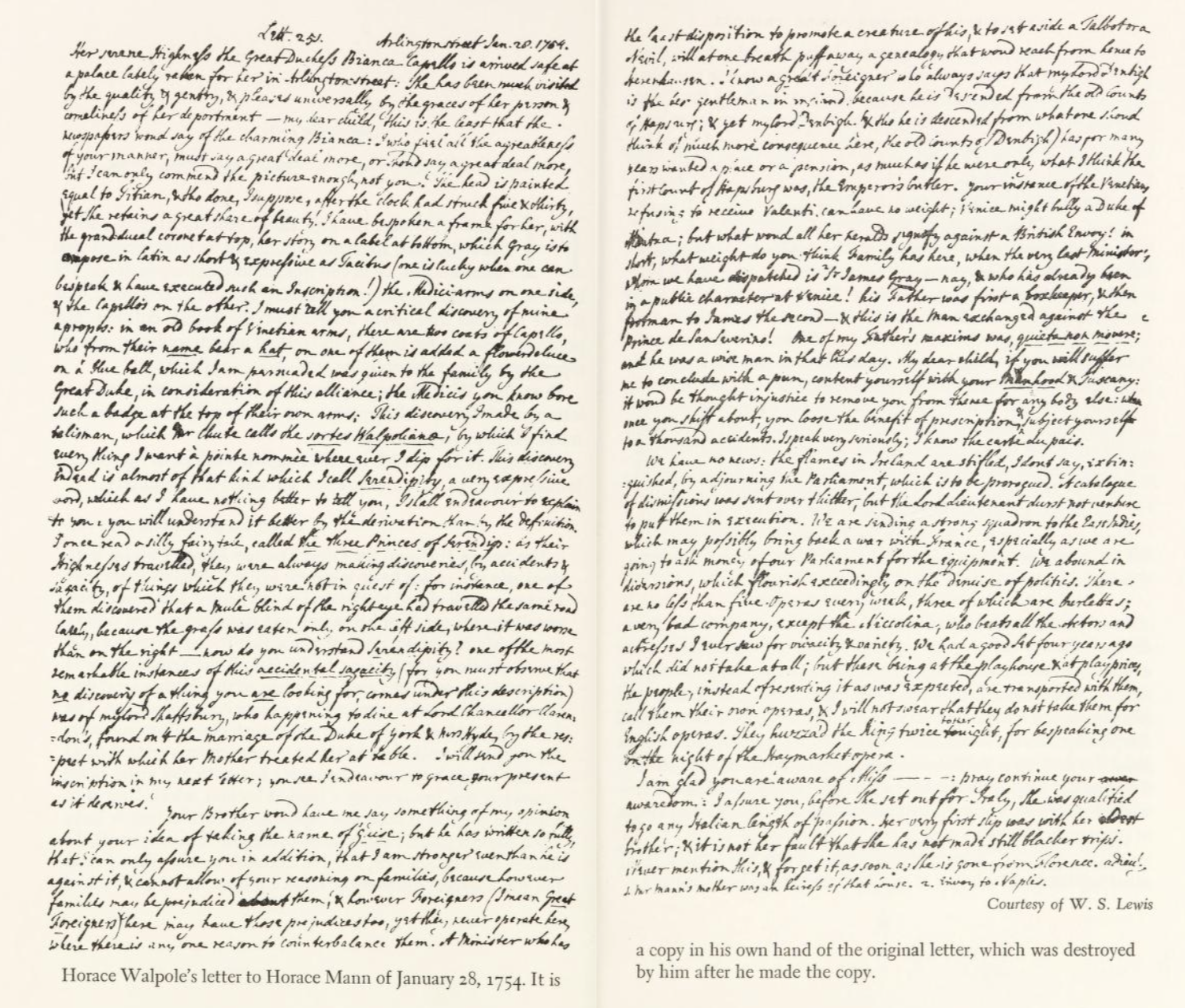
On pages 108–109, Merton returns to Walpole’s original 1754 letter to Horace Mann. He had already quoted it earlier, but now he examines it with noticeably greater intensity.
It is as if something in that letter lingered in his mind. This time Merton observes, with his usual precision, that Walpole’s definition refers confidently to “discoveries by accidents and sagacity” — yet Walpole offers no example of such discoveries, no description of what is found, no explanation of why these finds would matter, and no evidence that the original tale actually contained “accidental discoveries” at all.
Merton does not press the point. He simply notes the mismatch, almost gently, and moves forward. But attentive readers may sense a quiet tension here — a slight hesitation between Walpole’s definition and the story he claimed to derive it from.
It is one of those places where Merton, without saying too much, invites us to reflect further.
4. Why Read Merton Today?
Beyond the scholarship itself, this book remains deeply relevant. even today. It teaches us:
-
how cultural narratives shape scientific concepts
-
how easily definitions can drift
-
how origin stories become simplified through retelling
-
how language acquires authority even when its roots are uncertain
-
how important it is to read sources carefully, line by line
And perhaps most importantly: It shows that even the most established ideas carry mysteries — and that those mysteries wait patiently for curious minds to revisit them.
Final Reflection
The Travels and Adventures of Serendipity is more than a history of a word.
It is a study of how ideas evolve, how meanings shift, and how intellectual traditions sometimes rest on surprisingly fragile foundations.
If you want to understand serendipity deeply — not as a buzzword but as a meaningful cultural and scientific concept — this book is essential.
And if, while reading it, you notice a few anomalies or small inconsistencies that make you raise an eyebrow…
well, you will be in very good company.
More on that — soon.



You said “Walpole offers no example of such discoveries”. Well he does.
He attibutes the discovery of the coat of arms of a hat, in italian- “Capello”,
in finding Bianca Di Capello, the woman he desires to find and is in love.
He makes parallel to the findings of the princes of Serendip as they will
eventually lead up in a magical good ending like he was aspiring with Bianca.
What he didnt know back then, when writing to Mann, was that she was
already dead by more than a houndred years.
btw I just LOVE all your articles. Thank you again!
Greetings form Switzerland! Perhaps you are asking too much of Walpole? He classified his coat of arms example – surely that was all he wanted to do. The usefulness of the concept was later recognised, and thanks to your tips, I found the people for the Wikipedia article who ensured that the term was not forgotten and had already been explored before Merton. I think that with Merton, we must also take into account that he wanted to be considered a ‘serious’ sociologist and saw some danger in the concept being more speculative. I am looking forward to reading the book.
Great to hear from you, Klaus — thank you for your thoughtful comment. I hope you are well.
The book is currently in its final editing phase and is expected to be released in February 2026. Over the past 14 months, I have immersed myself deeply in the origins of serendipity, particularly the early interpretations following Walpole’s coinage.
Based on this research, I take a rather critical view of Walpole’s own understanding of the Peregrinaggio. His interpretation turns out to be surprisingly loose and, in key respects, misleading when measured against the actual lessons embedded in the story of the Princes. Merton himself was quick to notice this slippage and treated Walpole’s framing with notable caution.
What I find most striking is that Walpole effectively distanced himself from his own coinage soon after introducing it. The subsequent spread and influence of the term serendipity occurred not because of Walpole’s theoretical clarity, but largely in spite of his initial framing. These dynamics — and their consequences — are documented in detail in the book.
I very much appreciate your interest and look forward to continuing this conversation.
Thanks, I stay tuned and with your book in hand we will then actualize the Wikipedia Article. Good luck for the book, the interest on serendipity will increase. Important to show the „serious shoulders“ where it is standing on.
Btw: last time your system told me that I am not a human 😉 Let’s look now…